
About Us

The WJP is an independent, multidisciplinary organization working to advance the rule of law worldwide.
Our Work

We engage advocates from across the globe and from multiple work disciplines to advance the rule of law.
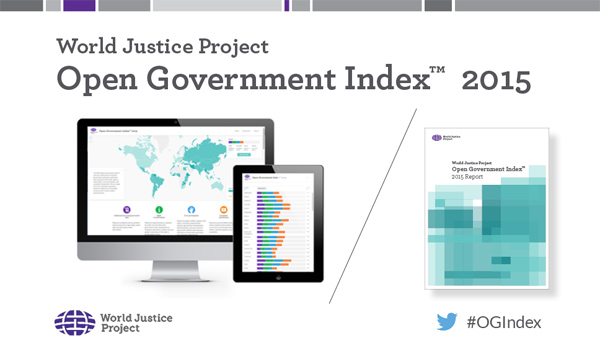
Today we are pleased to introduce the World Justice Project (WJP) Open Government Index™ 2015, the first effort to measure government openness based on the general public’s experiences and perceptions worldwide.
The WJP Open Government Index presents scores and rankings for 102 countries organized around four dimensions: publicized laws and government data, right to information, civic participation, and complaint mechanisms. Scoring for the Index is drawn from more than 100,000 household surveys and in-country expert questionnaires.
In addition to global, regional, and income-peer scores and rankings, the WJP Open Government Index interactive data site displays selected survey responses by country, with gender and socio-economic breakouts. An accompanying report provides global insights on the relationship between open government and other aspects of governance and development:
- Socio-Economic Status: In 80% of countries low-income respondents are less aware than high-income households of their right to information. In 68% of countries low-income respondents are less likely to request information from the government.
- Open Government and Gender: In 76% of countries women are as likely as men to request information from a government agency. However, in half of all countries surveyed, women tend to be less aware than men of laws supporting their right to access government-held information.
- Awareness: Worldwide, less than half (40%) of survey respondents know of any laws supporting their right to access government-held information.
We will be posting news and coverage about the WJP Open Government Index throughout the coming days to our website and social media channels—watch for the hashtag #OGIndex. For more information, see our report landing page at: http://worldjusticeproject.org/open-government-index/