About Us

The WJP is an independent, multidisciplinary organization working to advance the rule of law worldwide.
Our Work

We engage advocates from across the globe and from multiple work disciplines to advance the rule of law.
The World Justice Project (WJP) on February 28 released the WJP Rule of Law Index® 2019, an evaluation of rule of law adherence worldwide based on more than 120,000 household and 3,800 expert surveys in 126 countries. Featuring current, original data, the WJP Rule of Law Index measures countries’ rule of law performance across eight factors: Constraints on Government Powers, Absence of Corruption, Open Government, Fundamental Rights, Order and Security, Regulatory Enforcement, Civil Justice, and Criminal Justice.
The new WJP Rule of Law Index scores show that more countries declined than improved in overall rule of law performance for the second year in a row, continuing a negative slide toward weaker rule of law around the world.
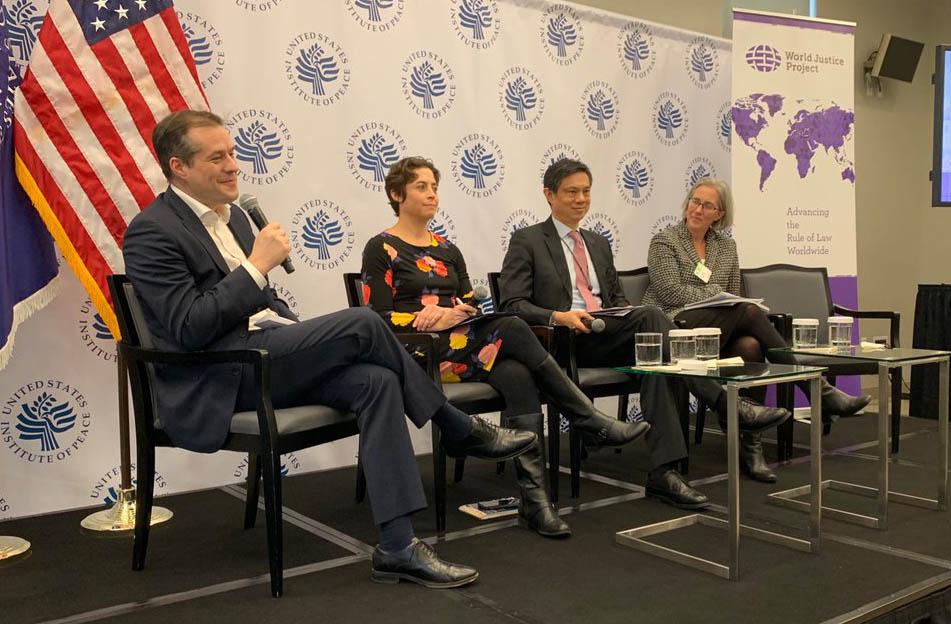
Watch the launch video below, including presentation of the data by WJP's chief research officer and analysis from a panel of experts. Download the report, and explore insights and interactive data here.
Speakers
- Bill Taylor, welcoming remarks, Executive Vice President, U.S. Institute of Peace
- William Hubbard, welcoming remarks, Board Chair, World Justice Project
- Elizabeth Andersen, Executive Director, World Justice Project
- Dr. Alejandro Ponce, Chief Research Officer, World Justice Project
- Maria Stephan, Director Nonviolent Action, U.S. Institute of Peace
- Hoyt Yee, Senior Fellow, U.S. Institute of Peace
- Philippe Leroux-Martin, moderator, Director Governance Justice and Security, U.S. Institute of Peace