About Us

The WJP is an independent, multidisciplinary organization working to advance the rule of law worldwide.
Our Work

We engage advocates from across the globe and from multiple work disciplines to advance the rule of law.
The 2025 WJP Rule of Law report for Thailand explains trends in institutional trust, fundamental rights, and the rising challenges of discrimination and corruption.
Download the Thailand Rule of Law Report
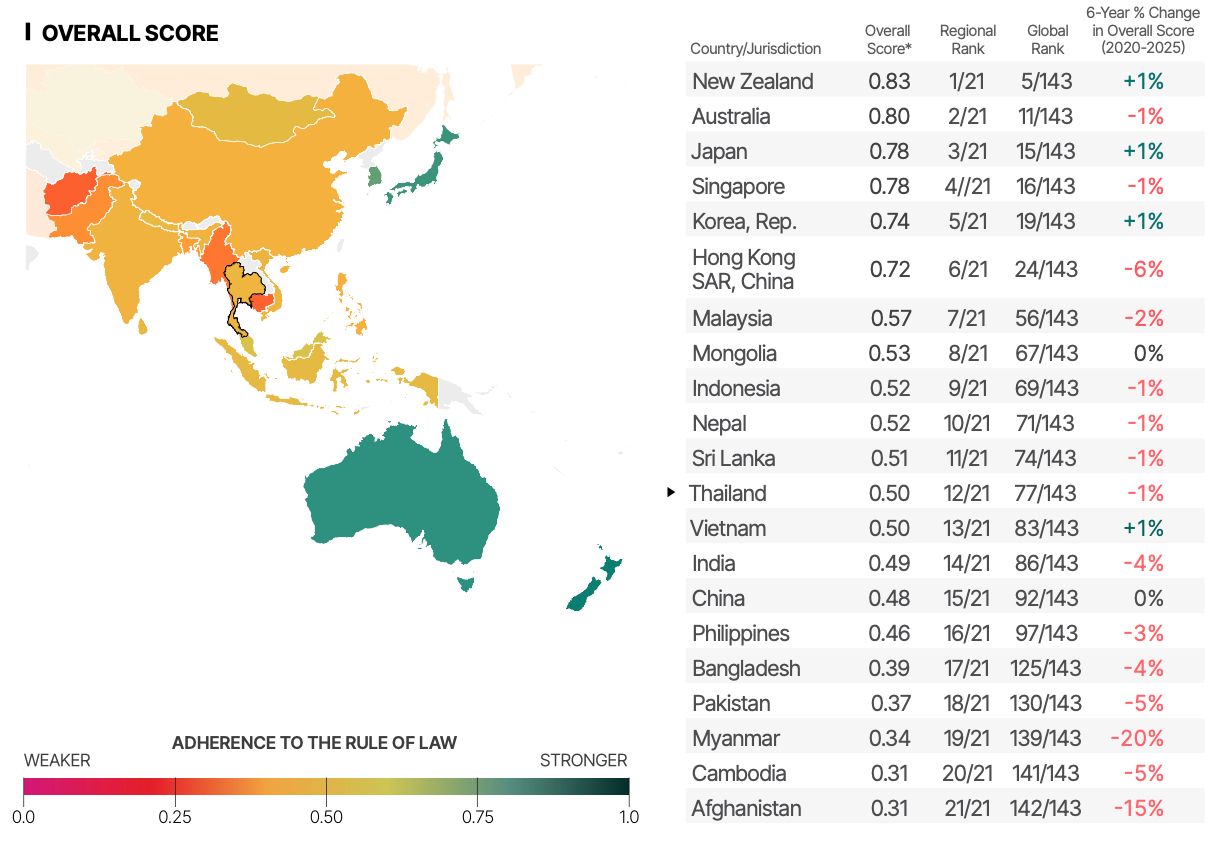
The latest World Justice Project (WJP) Rule of Law Index 2025 reveals a complex picture of Thailand's legal and social ecosystem. While the nation maintains a stable overall score of 0.50, placing it 77th globally out of 143 countries, the "lived experience" of Thai citizens tells a story of both remarkable progress and emerging challenges.
Below, we break down the executive findings from the 2025 General Population Poll (GPP) to see how the rule of law is evolving in Thailand.
Stability in a Global Recession
While 68% of countries worldwide experienced a decline in the rule of law this year, Thailand’s performance remained stable, even reflecting a minor underlying improvement.
-
Regional Standing: Thailand ranks 12th out of 21 regional peers in East Asia, the Pacific, and South Asia.
-
Southeast Asian Context: Thailand outperformed several neighbors, including Vietnam (0.49), the Philippines (0.46), and Cambodia (0.31). However, it continues to trail behind higher-performing neighbors such as Indonesia (0.52), Malaysia (0.57), and Singapore (0.78).
High Trust in the Justice System
One of the most encouraging trends is the rising level of trust in institutional actors.
-
The Judiciary: Judges and magistrates are the most trusted figures in the country, with 80% of respondents expressing confidence in them.
-
Police Officers: Trust in the police saw the largest gain, rising from 50% in 2018 to 62% in 2025.
-
Legal Professionals: 76% of people trust prosecutors, and 73% trust public defense attorneys.
Improving Fundamental Rights vs. Rising Discrimination
The data shows a dichotomy between perceived political freedoms and personal experiences with equality.
-
Freedom of Expression: Overall, indicators related to freedom of expression have improved since 2018. For example, the share of respondents who believe that citizens can express opinions critical of the government increased from 68% in 2018 to 85% in 2025.
-
The Discrimination Surge: Despite better political freedoms, self-reported discrimination has nearly tripled, rising from 10% in 2018 to 28% in 2025.
-
Primary Drivers: Respondents cited age (33%), physical appearance (28%), and gender (27%) as the leading causes of discrimination.
Corruption: A Mixed Bag
While institutional corruption perceptions are creeping upward, "petty corruption" in daily life is actually on the decline.
-
Victories in Public Service: Bribery to secure public school placement plummeted from 14% to just 1%.
-
The Permitting Exception: Government permitting remains a major pain point, with bribery rates nearly tripling from 7% to 19%.
-
Legislative Concerns: Members of Parliament (45%) and national government officers (40%) are perceived as the most corrupt institutional actors.
Urban vs. Rural Perspectives
The report highlights a significant "perception gap" based on where people live.
-
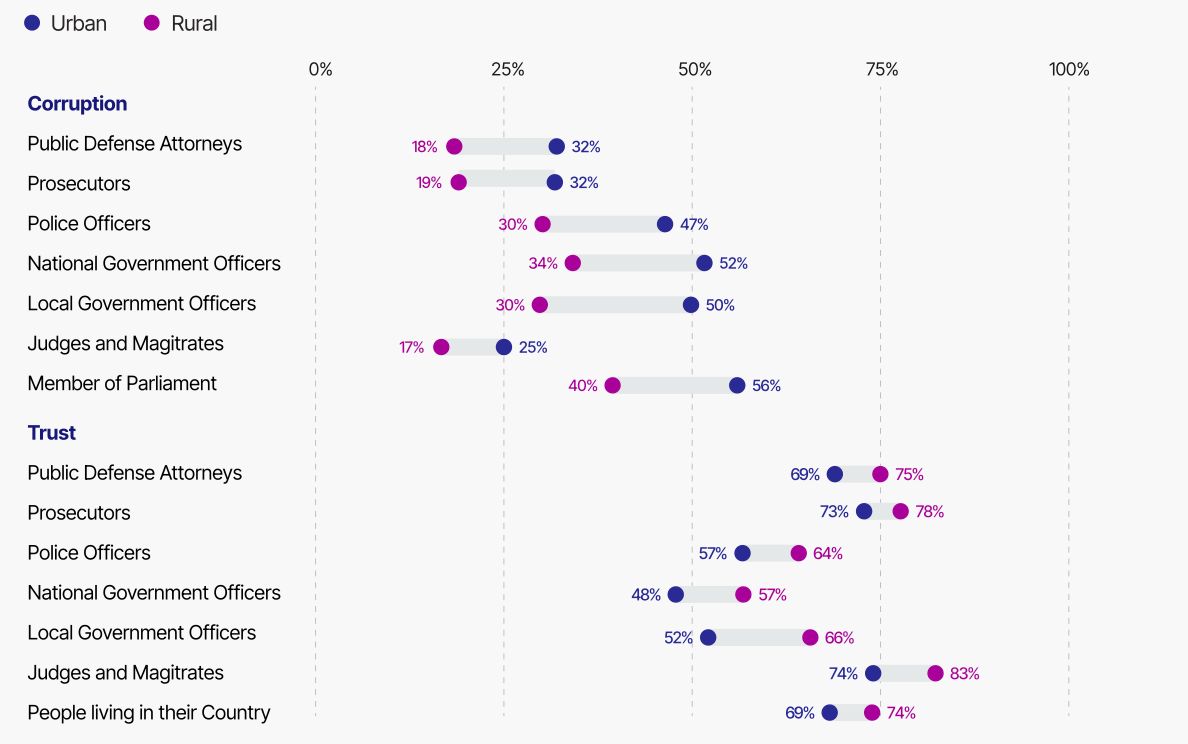
Rural Optimism: Residents in rural areas generally hold more positive views of the rule of law, trust institutions more, and perceive lower levels of corruption than their urban counterparts.
-
The Disparity: For example, 30% of rural residents perceive the police as corrupt, compared to 47% of urban residents.
An Encouraging Path Forward
Thailand’s rule of law journey is characterized by high levels of community security and a justice system that maintains the respect of its citizens. However, the sharp rise in self-reported discrimination and persistent corruption in government permitting highlight critical areas for reform.
Read the full Thailand Rule of Law Report
This article was written by our Senior Data Analyst, Santiago Pardo.