

About Us

The WJP is an independent, multidisciplinary organization working to advance the rule of law worldwide.
Our Work

We engage advocates from across the globe and from multiple work disciplines to advance the rule of law.
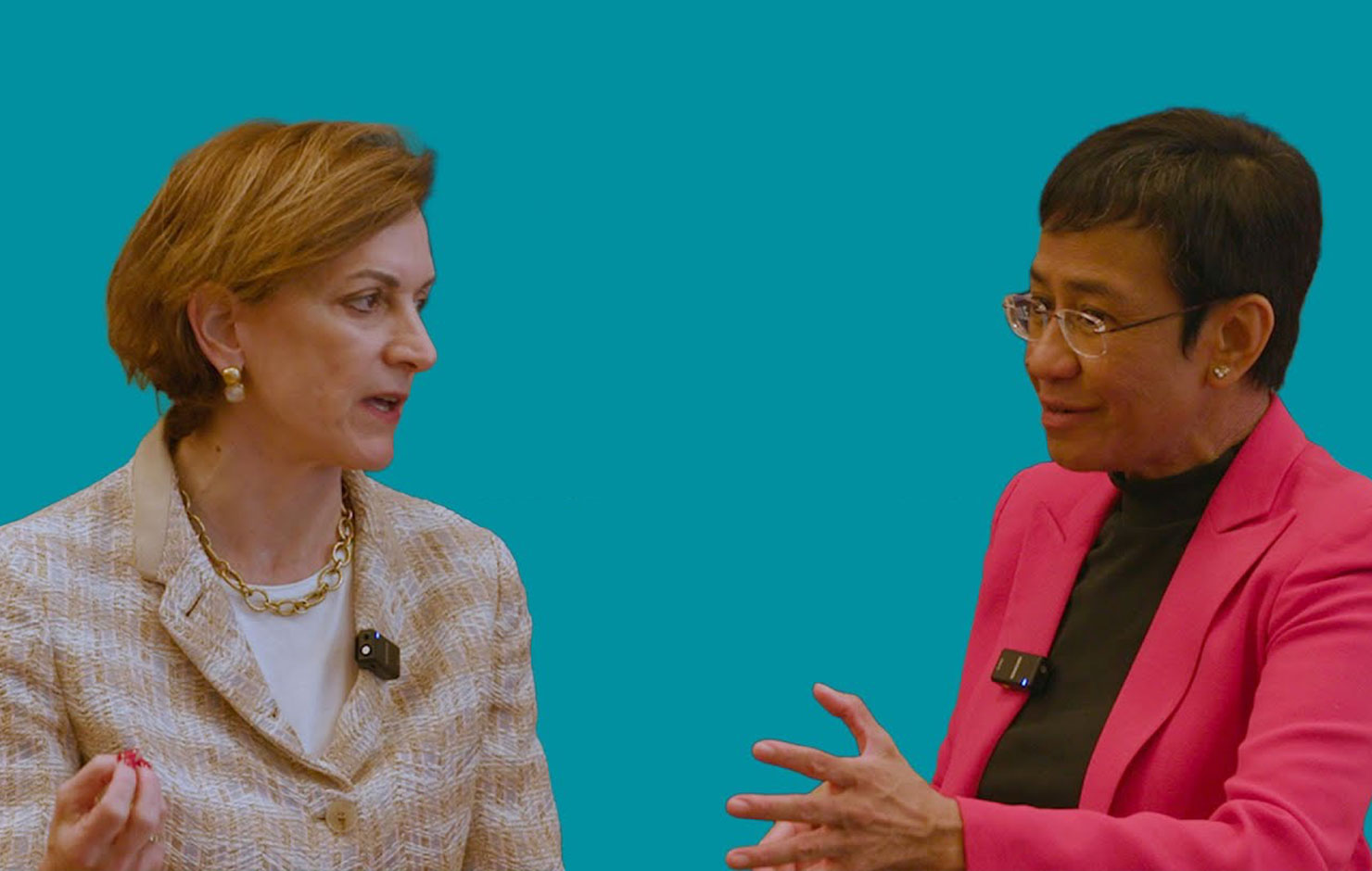
In the first of WJP’s “Changemakers on Change” series, Pulitzer Prize-winning journalist Anne Applebaum and Nobel Peace Prize laureate Maria Ressa come together for a powerful conversation on democracy, technology, and the rule of law.
Filmed at the World Justice Forum 2025 in Warsaw, they unpack how autocratic regimes weaponize digital tools, how social media and generative AI are fracturing societies and starving news organizations of oxygen, and—most critically—what the world must do to defend truth, press freedom, and information integrity.
Maria Ressa: Hi, I’m Maria Ressa, and we’re at the World Justice Forum in Warsaw, With me is Anne Applebaum, whose most recent book, Autocracy, Inc. goes beyond and tells us what actually is happening, like how have we moved from this post-Cold War world that has damaged democracy. What’s happening?
Anne Applebaum: So, the book describes a network of dictatorships. It’s not all dictatorships, it’s not everyone in the world, and they aren’t people, they aren’t organizations, they aren’t political parties who necessarily share an ideology. What they do share is a conviction that the language and the ideas of democracy, and of the rule of law, and human rights are a threat to them. We’re talking about Russia, China, Iran, Venezuela, Zimbabwe—countries all over the world who have identified those ideas as a threat, and who seek to undermine them. And they seek to undermine them mostly because they’re interested in defeating their own political opponents at home, whether it’s Alexi Navalny’s anti-corruption movement, or whether it was the Hong Kong’s democracy movement, or the Iranian women’s rights movement. But they also came to understand that in order to win these arguments, they needed to work globally. And so, the book is partly about that, their development of an authoritarian narrative, and how it spreads. In the case of Russia, their use of military force and actions as well to undermine what they perceive as a democratic or western alliance.
Corruption is the Backbone of Autocracy
Ressa: In the old days, it almost felt like that every accountability-story journalists did ultimately came down to corruption, but now it feels, and you point this out, right? It’s like, the growth of these types of authoritarians or dictatorships are deeply connected to corruption.
Applebaum: They are. They exist for corruption. The leaders of Russia, the leaders of China, these are billionaires. We don’t know how they’re billionaires, or why, or how their money came to be, or where it is necessarily, but we know that they’re very wealthy and the people around them are also extremely wealthy. And this of course gives them a different kind of influence in the democratic world than the dictators of a previous era once had. They can buy people, and they also are attractive to people. So don’t underestimate the attraction that kind of wealth has for, you know, the young Donald Trumps of the world. You know, people just starting out in the real estate business in New York, I mean, they would see the Russian Oligarchs as something to admire, and so they’ve had an effect not only in their own societies, but also in the democratic world.
Rule of Law vs. Rule by Law
Ressa: And ultimately that corruption, the kind of power that they have, what does it do to rule of law?
Applebaum: If you have power and money and the will to undermine rule of law, then, you know, what’s in your way? There are autocracies and there are declining democracies, but if we’re talking about autocracies, these are countries where they already control, there is no rule of law, there’s instead rule by law, meaning that people in charge decide what the law is. There is an argument, it’s funny, I heard it made once by an Ukrainian friend, that it’s precisely because of the need to steal and then keep your money, that leaders in declining democracies begin to undermine the rule of law. In other words, if you have begun to use your political system for personal gain, then you have a big interest in shutting down journalism, in ending whatever government inspectors there are, in controlling the courts, you know, all those efforts to undermine those institutions very often begin with politicians who just want to steal.
Ressa: I’m both Filipino and American, and to see this happening twice, we lived through it in the Philippines with Duterte, we had a strong six year term and the only reason it ended was because the military and police maintained the rule of law. But to watch this happen the United States, like, how is it possible? The Philippines’ constitution is patterned after the US, but to have the executive not have a legislature be able to check. How is this happening?
Applebaum: In the US, this is happening because the Republican legislature is refusing to check the president. I mean, it has the right to check the president. In the American system, the Congress determines how money is spent, including what taxes are imposed. A tariff is a tax. So there is no reason why the president should be able to randomly declare tariffs on whoever he wants, or to raise them or lower them according to his mood or according to whether the leader of a particular country is nice to him. I mean, that’s actually anathema to our system, it’s not supposed to work that way.
Ressa: Or even bombing Iran. I mean, aren’t these are impeachable offenses?
Applebaum: Of course they’re impeachable offenses. I mean, the military question is a little bit more fraught because we’ve had a decline in Congress’s control over military power that goes back decades. So that’s actually been undermined for a long time. But the tariffs is new. I mean the president is actually using a kind of fake emergency to give himself the power to declare these tariffs, but this is something Congress should be able to block, but they don’t want to. So our Constitution was written on the assumption that the players would play their roles, that they would do their jobs. You know that Congress would do its job, the Supreme Court would do its job. And when that doesn’t happen, this is when you have a breakdown.
Big Tech’s Impact on Democracy
Ressa: The role of big tech, these American tech companies that are in our part of the world have really rought havoc on democracy. What role is it playing now?
Applebaum: Well, this is where I'm going to start asking you questions, because the role of big tech is critical, and you are the person who's explained this better than almost anybody else. What the algorithms of technology have done? Is they've enabled the fracturing of public space. They've made it much more difficult for people to organize but also even understand what’s going on. They've made it hard for people to know what's true and what's not true, and they've undermined the role of people who do spend their time going out in the world and collecting information and presenting it to people, whether in the form of journalism, or in the form of government reports or inspections. And so the fundamental problem isn't particular people or particular autocrats, it's this underlying system and structure which has infected the United States perhaps worse than anywhere else, but you can see the impact all over the world. I mean, I think the reason for the decline in the rule of law around the planet is the same. And this is where I wanted to ask you, because you had spent more time thinking about this than almost anybody I know, and you have worked a lot on what the alternatives are. So, you know, is it enough just to do really good communication strategies to reach people in different forms of media and social media, or is there something else that we should be doing to recreate some sense of shared public space?
Ressa: We’ve done that, like Rappler was set up in 2012, and we lived on social media. And then from 2012 to around 2014, they didn’t have the same algorithms. Remember, Sheryl Sandberg was brought in in 2008, and then she began, it was really around 2014, where we began to see information operations and much more aggressive algorithms, a lot of it for micro, for making money for the tech platforms. The destruction of democracy, that was a byproduct. The main goal was keep you scrolling, which means more revenue, so the surveillance capitalism business model, and we didn't even have a name for that business model until 2019. That was when Shoshana Zuboff wrote The Age of Surveillance Capitalism. I lived through it because I could see the data on a daily basis, minute per minute. And from 2012 to 2016 we had a mood meter. We had a mood meter before the emoji of Facebook. So from 2012 to 2016, the most voted mood in the Philippines was happy, Filipinos were happy. And then all of a sudden in 2016, when Rodrigo Duterte began working with Facebook, that fundamentally shifted almost overnight with the campaign.
The Business Model of Surveillance
Applebaum: Sorry, you say he worked with Facebook, explain what happened because I'm not sure everybody knows.
Ressa: Yeah. So, Facebook aggressively — again did they plan this? I watched it, the strands come together. Katie Harbath was then in the Philippines. They offered, as they did with Donald Trump later that year, they offered to work with the candidates. I don't think they even realized that by doing that, they were compromising integrity, information integrity. And Rodrigo Duterte worked with them.Hhis campaign worked with them. That was when we began to see what we later called information operations.
Our first report came out in August of 2016, and it was about disinformation. I watched how the radicalization, my second book is called From Bin Laden to Facebook, and I was talking about like in 2011, there were jihadists in the Philippines who were calling for a global jihad, come to the Philippines for a global jihad on YouTube.
So, we were tracking this and the radicalization that led to men like the Bali bombers, for example, has been unleashed online now to the public, making politics a gladiators battle to the death, right? That kind of extremism. Polarization was one algorithm that every social media platform used, which was a friend of friend algorithm. So how do they grow? I will recommend friends of friends to you, and they found by AB testing it that you would be more prone to grow your network and in growing your network, you grow their platform. Every single social media platform used this. And then we saw that shift in the Philippines because we had the data.In 2016, if you were pro Duterte, with the friends of friends algorithm, you move for the right. If you're anti Duterte, you move further left. And over time that chasm grew. I mean you can replace Duterte with Trump, with Orbán, the way we survived the Duterte administration was to take what we used to do as investigative journalists and splinter it off as a separate company because the administration essentially tried to shut us down by telling our advertisers to stay away. We dropped 49% of our advertising revenue within the first four months of the shutdown order on Rappler. Anyway, why am I saying that? Because I'm absolutely convinced, based on the data, that no news organization can survive on the design of the social media platforms. And that's not just that, right? We saw active choking of new sites beginning in January of 2023, Meta was straightforward, they just choked traffic to new sites, and that caused anywhere from a 50% to an 85% drop in traffic to new sites all around the world.
And then Google with generative AI also began. Now you when you get Google, you get the generative AI summary up top. They no longer send traffic to news sites. So traffic to news websites decreased even as generative AI came on. And then what Cory Doctorow called the enshitification of the internet, like you can't tell fact from fiction even more, right? I don't know if you saw the video of Donald Trump and the three men behind him, his cabinet secretaries, has now been like re-mind, re-done by generative AI. And while it's funny, it's also scary because I've had deepfakes done, the Pope has had deepfake, I'm sure you have a deepfake. I have a deep fake selling crypto, I've never sold crypto. I have a deepfake telling people with diabetes to throw away their insulin, don't do that. You know, so we're getting to this stage where I think it's not just democracy. I don't think journalism will survive.
So, what we did was three years ago we began looking at how can we have information integrity, what's a different version of the internet? And it was actually France and Germany that led the way forward here, the UK as well at some point.
Creating an Alternative
Applebaum: So, you used work done in France and Germany?
Ressa: Yes. Well, so President Macron, named… I was the only non-French in a six-member team. He gave money to talk to the French people about what you think about AI. We came up with 15 proposals, and one of those is open source, decentralized, end-to-end encrypted. We need to protect ourselves online because data privacy is a myth, and it is the worst in America.
Applebaum: Tell me what you built.
Ressa: Okay, so the matrix protocol is something that was built by a UK company called Element in 2014. Who uses it? The German government. All their websites are on it. The German military, the German intelligence, the French government, all their websites are on it. The Taiwanese use the matrix protocol for consultation. And what we did is we began to think of a federation of news organizations. Instead of like BlueSky, which is a social media derivative, right? Modeled after social media. Instead of thinking like, I will get you and you and you and you, why not bring the community of news organizations into the matrix protocol? Rappler has 15 million uniques. What about South Africa? What about Brazil? Our MVP was Rappler. We rolled it out the end of 2023.
Applebaum: So, it's a form of online conversation.
Ressa: It's a safe virtual world because right now we have outsourced the internet to private companies and those private companies are driven by profit and that drive for profit, the business model is toxic, not just for journalists, but for information integrity.
Applebaum: And how does how does your system work differently?
Ressa: It's a federation of news organizations. So, this is still a dream. But what we do have is an MVP with Rappler, and then an Indonesian partner is about to start building, we have a South African partner and a Brazilian partner. The countries to me that, you know, we've lived through, I always joke with Brazil, we moved from hell to purgatory, and we don't want to go back to hell, right? So, what we're trying to do is, in Rappler, what are the new business models for news? We found three. By creating your own data lake, by moving away from Silicon Valley's ideas of what the public sphere is, how do we create a public interest tech stack? And that was the exercise we went through. We built it. And here's the hard part. You don't really make money at it. It should have been something governments, democratic governments, did. The same way they would build a library or create a park, right? We're being pushed into tech spaces that by design manipulate us and, as a byproduct, kill democracy. Sorry, it is true. I have all the data. Which country do you want? I will give you the data.
When I wrote How to Stand Up to a Dictator, I wrote double the number of pages, I wrote 400 pages. And then my editor said, “Maria, 400 pages? Do you want the person to read it cover to cover or know everything you know?”
A Public Interest Tech Stack
Applebaum: Okay, then let's finish on the two-sentence version of what it is that you've proposed and created and how it works.
Ressa: It's a public tech stack, right? The technologists would know the tech stacks are how it's kind of like pushing servers together. So, it's the technology that would allow news organizations to be able to create. It's called Federation, but it's like Mastodon, if you know that. But the problem with Mastodon is when you go on Mastodon...
Applebaum: You're over two sentences.
Ressa: Oh my God, it's hard. And you know, the hard part? A funder for journalism doesn't care about the tech, and a tech funder despises journalism.
Applebaum: So, tell us. Essentially, you're talking about creating a technology that would allow newspapers to survive...
Ressa: News organizations. So, it's a public interest tech stack that would allow news organizations to have public debates without people being insidiously manipulated.
Applebaum: Okay. That makes sense. And what's it called?
Ressa: It's the Matrix Protocol Chat App is what we did. So, all we did is we built on top of existing tech for a new service. All you have to do, for the Atlantic, is log into the Atlantic and then you can be part of a federated system. If Sam follows the Atlantic, Bob follows Rappler, Sam and Bob can talk to each other without our news organizations ever sharing their data. It's restoring data privacy again.
Applebaum: Then that's what we should all adopt.
Finding Hope
Ressa: Oh, I love you, Anne. Wait, so last, my last question to you is, this is a this feels like such a tenuous moment, right? Like, we have a United States that can essentially pull us all into a fascist world. Where are you finding hope?
Applebaum: I find hope by doing things. By writing, by talking to people, by being part of organizations.
Ressa: Is it enough?
Applebaum: Well, I don't think hope is something that can ever come from outside or from something somebody says. You know, I think that, you know, there are a lot of people who are now engaged in politics and in public debate in a way that they weren't before, especially younger people, and they will create the hope.
Watch the complete Maria Ressa × Anne Applebaum interview on YouTube from the #WJForum2025: