
About Us

The WJP is an independent, multidisciplinary organization working to advance the rule of law worldwide.
Our Work

We engage advocates from across the globe and from multiple work disciplines to advance the rule of law.
A healthy environment is critical to public health, ecosystem vitality, and the sustainability of societies. A majority of countries have endorsed this view and adopted environmental laws or included the right to a healthy environment in their constitutions. However, practice often lags behind the adoption of environmental laws, and to date, there have been very little data to help understand and address this gap.
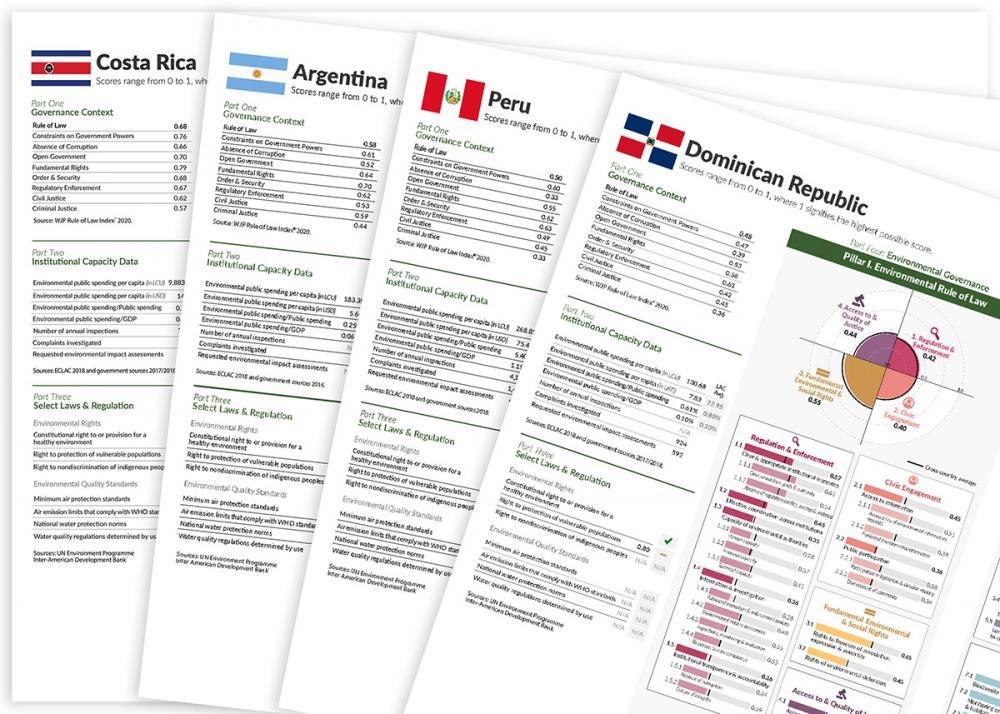
The newly-released report on Environmental Governance Indicators for Latin America and the Caribbean© (EGI) represents an effort to address this challenge by measuring how environmental governance functions in practice in ten countries in the region: Argentina, Bolivia, Brazil, Colombia, Costa Rica, the Dominican Republic, El Salvador, Jamaica, Peru, and Uruguay. This study is the result of a collaborative research effort undertaken by the Inter-American Development Bank (IDB) and the World Justice Project (WJP).
Data Insights Highlights
Analysis of the primary data on environmental governance collected for this study reveal 19 key insights, six of which are highlighted below. Please see the "Data Insights" section of the report for a more detailed discussion of these findings.
Upcoming Webinar
The IDB and WJP will hold a public webinar in November to present the methodology and key data insights from the EGI as well as to discuss the results of the study with country experts. Please stay tuned for event details!