
About Us
The WJP is an independent, multidisciplinary organization working to advance the rule of law worldwide.
Our Work

We engage advocates from across the globe and from multiple work disciplines to advance the rule of law.
Justice Viktor Prorok joins In the Robe to discuss maintaining the rule of law during full-scale war. Learn about court relocations, wartime electronic hearings, judicial independence, legal AI ethics, and transparent reforms required for EU integration.
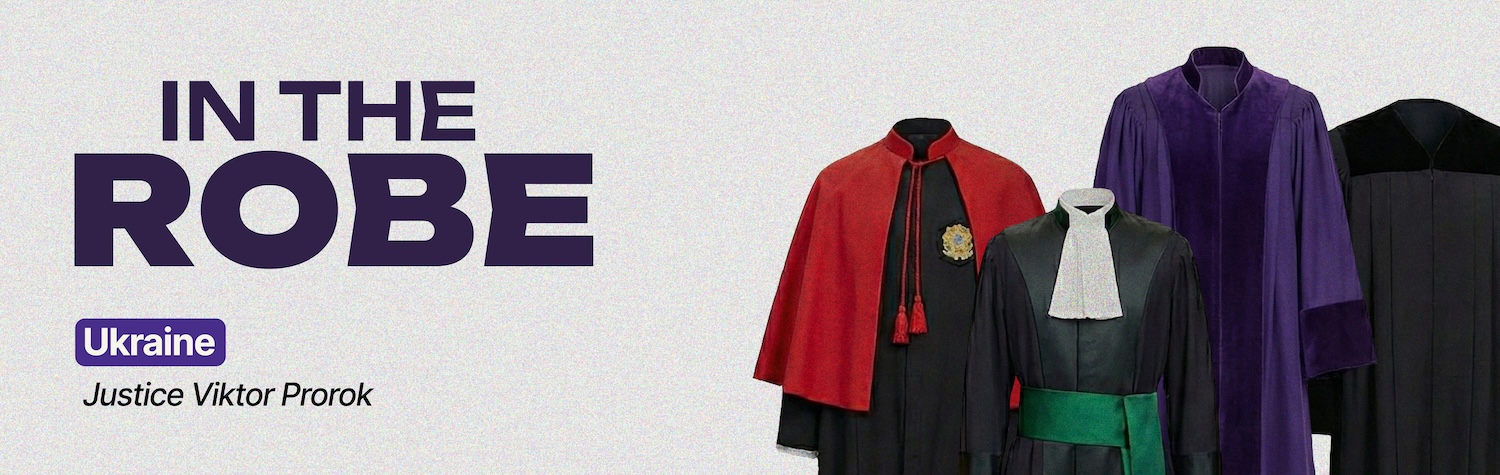
Justice Prorok serves on the Civil Cassation Court of the Supreme Court of Ukraine.[1] Before joining the Court, he practiced law for more than a decade in the private sector. He is widely recognized for his work on civil justice, judicial independence, and public engagement. In addition to his judicial duties, he has served as judge-spokesperson of the Supreme Court and has actively contributed to international judicial dialogue. In 2025, he was selected as a Judicial Fellow of the U.S. Chamber Foundation's Judicial Fellowship Program, which brings together judges to strengthen judicial leadership and advance the rule of law.
We interviewed Justice Prorok in May 2026.
It is the second podcast in a series that also explores navigating Sharia law in Malaysia and women’s rights in Kenya.
Marta Basystiuk (WJP): Welcome to the In the Robe, a series where we sit down with judges from around the world to discuss the future of justice. I’m your host, Marta Basystiuk from the World Justice Project. Through these conversations with current and former judges, we explore the challenges and triumphs of judiciaries across the globe.
Today's guest is Justice Viktor Prorok of the Supreme Court of Ukraine, who will be sharing his unique experience of serving the bench during wartime.
Justice Prorok, thank you very much for joining us today. Slava Ukraini!
Justice Viktor Prorok (Ukraine): Heroyam Slava! Thank you very much for the warm welcome and for inviting me to In the Robe. It is an honor to represent the Ukrainian judiciary in this important conversation, especially at a time when the rule of law is being tested so severely in my country.
It's our absolute honor to have you today. Thank you again. And I'd like to begin with your professional journey. You started your career in private sector but later moved to public service and to the Supreme Court of Ukraine. I'm wondering what drew you to the bench, and was there any specific experience that shaped that decision?
I began my legal career in private practice. I used to be an attorney at law. In the private sphere, success is measured by achieving results for the clients. That experience was extremely valuable, it taught me how the law actually works in real life, for ordinary people, or for businesses.
However, over time, seeing all the problems the Ukrainian judiciary was facing, I felt a stronger calling to influence in some way. I wanted to contribute directly to upholding the rule of law and to restoring public trust in the Ukrainian judiciary. And after the Revolution of Dignity,[2] it was the turning point when there came the major judicial reform. When the competition for the new Supreme Court was announced, I saw this as a historical opportunity to help build a truly new, high-quality judiciary. I believe my appointment to the civil court in 2017 was a conscious decision to serve the public interest at the highest level.
Yes, the idea of public service feels especially important right now. I would say not only for judges, but more broadly, because democracies depend on people like you who are willing to step into difficult roles and take responsibilities for protecting fundamental values. So let me ask you about that. In the context of Ukraine today, because of the war, the government had to act very quickly to protect public safety and national security. At the same time, people and businesses, they still need to know that power remains accountable, rights remain protected, and the law still applies fairly. So, from your perspective, what role has an independent judiciary played in maintaining that balance in Ukraine?
In wartime, the state quite naturally expands its powers to ensure national security and public safety.[3] At the same time, it is precisely in such periods that an independent judiciary becomes especially important as a guarantor to ensure that emergency measures do not turn into arbitrary restrictions. Even during the full-scale war, the Supreme Court continues to function as the independent arbiter. We review cases concerning the legality of actions by military administrations and other state authorities, protection of property rights, social rights, and compensation for war damages as well.
Even during the full-scale war, the Supreme Court continues to function as the independent arbiter.
In our decisions, we consistently emphasize that any restrictions of rights must be clearly defined by law, be necessary, proportionate, and predictable. And I believe, thanks to this, citizens and businesses retain confidence that even during full-scale war, there is an institution guided by the law rather than expediency. This balance is crucial for maintaining the legitimacy of the state power and public trust.
I think that’s exactly right. Maintaining public confidence in the law also depends on something very practical, as you mentioned, whether courts are actually able to continue functioning under very extreme circumstances. For many people outside Ukraine, it may be difficult to imagine what it takes to keep a justice system functioning during a full-scale war of aggression. Courts have faced bombardments, attacks on infrastructure, displacement, serious security risks, and ongoing uncertainty. What were some of the most important adaptations that made it possible for Ukraine’s courts to continue delivering justice throughout this period?
Yes, indeed, that was the challenge for the judiciary. Many courthouses were damaged or even destroyed.[4] I believe several key adaptations allowed the judiciary to keep functioning. Firstly, the rapid relocation of courts from occupied territories and frontline territories, as well as the changes in the territorial jurisdiction for those courts.[5] There was widespread implementation of remote court hearings through the electronic court system.[6] Technical resilience also played an important role, including the use of generators, Starlinks where available, and also different backup power systems during widespread blackouts.
Strong internal solidarity within the judiciary community was also very helpful. I think this experience taught us that true institutional resilience is not only about the laws and infrastructure. It is also about the people. Ukrainian judges and court staff continued to administer justice, even under shelling and in extremely difficult conditions. It proves that a committed and professional judiciary can remain operational even in the most extreme circumstances.
True institutional resilience is not only about the laws and infrastructure. It is also about the people.
You've mentioned that technology has been crucial to adaptability. In practical terms, how has technology changed the function of the Supreme Court of Ukraine? And where do you see the greatest opportunities or concerns for the future of justice?
I believe technology has fundamentally transformed our work. Electronic document management and video conferencing have become standard tools. During the war, these technologies literally allowed justice to continue without interruption.
During the war, these technologies literally allowed justice to continue without interruption.
As for artificial intelligence, I see significant opportunities in accelerating functions: fast analysis of large volumes of documents, search for similar case law, and even drafting preliminary texts. This can significantly increase the efficiency of courts. However, I am convinced that the core of a court decision, its legal reasoning, assessment of evidence, and moral responsibility must remain exclusively human. The greatest concern is the risk of losing personal accountability of the judge and potential algorithmic mistakes. Technology should assist justice but not replace the judge.
The role of the judge is evolving in this rapidly changing world. Judges will need to combine deep legal knowledge with ethical judgment and the ability to protect fundamental human values in the age of technologies.
That’s an important distinction, technology can support the work of judges, but it can’t replace their judgments and responsibility. As Ukraine continues its path toward EU integration,[7] what steps do you think matter most to strengthen judicial independence and public trust?
In the context of EU accession, I believe the most important steps are to first, finalize the reform of the High Council of Justice and the High Qualification Commission of Judges, ensuring that they are truly independent, professional, and transparent.[8]
The second step is to continue the evaluation process of judges based on the principles of integrity and professionalism. The third one is the strengthening the well-being and renewal of judges in order to minimize the corruption risks. I think, increasing transparency and openness of the judiciary, including timely publication of decisions and the clear communication with society about our decisions, is essential.
I believe public trust in judiciary is built when people see that judges are selected fairly. Decisions are well reasoned and predictable and are addressed regardless of the person's status.
Your experience highlights a very important point - the resilience of a justice system is tested not when conditions are favorable, but when institutions are under pressure. Based on what Ukraine's judiciary has gone through over the past several years, what lessons do you think are most relevant for judges facing instability or crisis?
I think the main lesson I would share is that in times of instability, a judge must remain a symbol of stability, calm, and commitment to the rule of law. They should be treated by people as the protector of their rights. We must strictly follow the law, resist external pressure, and base every decision on facts. Even in the most difficult circumstances we protect not only specific rights in individual cases, but also the very idea of justice in society. Professionalism, integrity, and inner conviction that law will ultimately prevail – these are the qualities that help judges endure wartime challenges. When people see the trust in judiciary, they see the trust in the whole state system.
When people see the trust in judiciary, they see the trust in the whole state system.
Maintaining judicial independence and impartiality remains non-negotiable. Openness should strengthen trust, not undermine the core principle that judges answer only to the law and their conscience.
Thank you for this thoughtful conversation and for sharing your perspectives at such an important moment, not only for Ukraine, but also for societies everywhere that value rule of law and justice. And thank you to everyone listening to the In the Robe by the World Justice Project. Until next time.
Footnotes
-
The Civil Cassation Court of the Supreme Court of Ukraine is one of the cassation courts within the Supreme Court of Ukraine. It reviews civil cases in cassation proceedings and helps ensure the uniform application of law by the courts.
Source: Supreme Court of Ukraine (2024) Civil Cassation Court Jurisdiction and Responsibilities. ↩ -
The Revolution of Dignity was a significant nationwide protest movement from November 2013 to February 2014 against corruption, abuse of power, and human rights violations, and in support of democracy and Ukraine’s European future. It led to a change of government and accelerated Ukraine’s political, constitutional, judicial reforms and European integration.
Source: Ukraïner (2021) What is important to know about the Revolution of Dignity in Ukraine?. ↩ -
Under Article 15 of the European Convention on Human Rights, a state facing war or another public emergency threatening the life of the nation may derogate from certain Convention obligations only to the extent strictly required by the emergency and consistently with its other international-law obligations.
Source: Council of Europe (2021) European Convention on Human Rights (Article 15). ↩ -
The destruction of courts, homes, businesses, and public infrastructure across Ukraine has been documented through the Register of Damage for Ukraine, an international mechanism established under the auspices of the Council of Europe to record damage caused by Russia’s aggression and support future compensation efforts.
Source: Council of Europe (2024) Register of Damage for Ukraine. ↩ -
To ensure continued access to justice during martial law, the territorial jurisdiction of courts unable to operate due to occupation, hostilities, or other wartime circumstances was reassigned to functioning courts in other regions of Ukraine.
Source: High Council of Justice (2024) Interactive Map of Court Jurisdiction Changes in Ukraine. ↩ -
Describes the use of the Electronic Court system, remote hearings by videoconference, and other measures adopted to ensure the continuity of justice during wartime.
Source: Supreme Court of Ukraine (2025) Effectiveness of Justice, Uniformity of Judicial Practice, and Protection of Rights in Wartime Conditions. ↩ -
As of 2026, Ukraine had opened accession negotiations in the following clusters of the EU accession process: Cluster 1 (Fundamentals), Cluster 2 (Internal Market), and Cluster 6 (External Relations).
Source: European Council (2024) EU Accession Negotiations with Ukraine. ↩ -
Reviews ongoing reforms of the High Council of Justice and the High Qualification Commission of Judges, including judicial appointments, integrity screening, and efforts to address judicial vacancies.
Source: European Commission (2025) Ukraine 2025 Report on Judicial Reforms and EU Integration. ↩