

About Us

The WJP is an independent, multidisciplinary organization working to advance the rule of law worldwide.
Our Work

We engage advocates from across the globe and from multiple work disciplines to advance the rule of law.
Businesses have become increasingly sophisticated at measuring financial, operational, geopolitical, and climate risk, but they still lack equally sophisticated tools to measure key sources of institutional risk. This institutional risk is the uncertainty businesses face from the lack of predictability, integrity, effectiveness and resilience of legal and governance institutions. It is also becoming a key determinant of investment decisions, supply-chain resilience, and long-term competitiveness.[1]
As judicial independence weakens, institutional checks and balances come under strain, and geopolitical fragmentation reshapes global markets, measuring and understanding institutional risk has become a market reality.
According to the latest WJP Rule of Law Index, the rule of law recession has accelerated as a majority of countries experienced declines for the eighth consecutive year, reflecting a global trend of institutional erosion.[2] When courts become politicized, regulations are enforced inconsistently, or corruption risks increase, companies face higher operational costs, weaker investor confidence, and greater uncertainty around long-term planning. In an increasingly volatile environment, strong rule of law which measures institutional risk is emerging as a core economic asset.[3]
This shift is already visible in the way companies make decisions. Multinational firms routinely rely on governance-related information to assess country risk, evaluate market entry opportunities, strengthen compliance systems, manage supply chain exposure, and inform ESG reporting.[4] Yet much of this analysis occurs indirectly through third-party ESG scores, sovereign-risk ratings, political-risk services, and aggregated governance proxies. The missing middle is robust, comparable data that helps companies understand how legal uncertainty, regulatory quality, judicial effectiveness, and government accountability shape the institutional environments in which businesses operate. This is where rule of law data provides a distinct advantage.
Sources like the WJP Rule of Law Index, the Corruption Perceptions Index[5] and the Global State of Democracy Indices[6] provide uniquely granular views of how laws and institutions function in practice across countries and jurisdictions. Unlike broad governance indicators, the Index measures the institutional conditions that directly influence business operations and investments, including corruption, regulatory enforcement, civil justice, government accountability, and constraints on state power.
Mapping legal certainty to corporate strategy
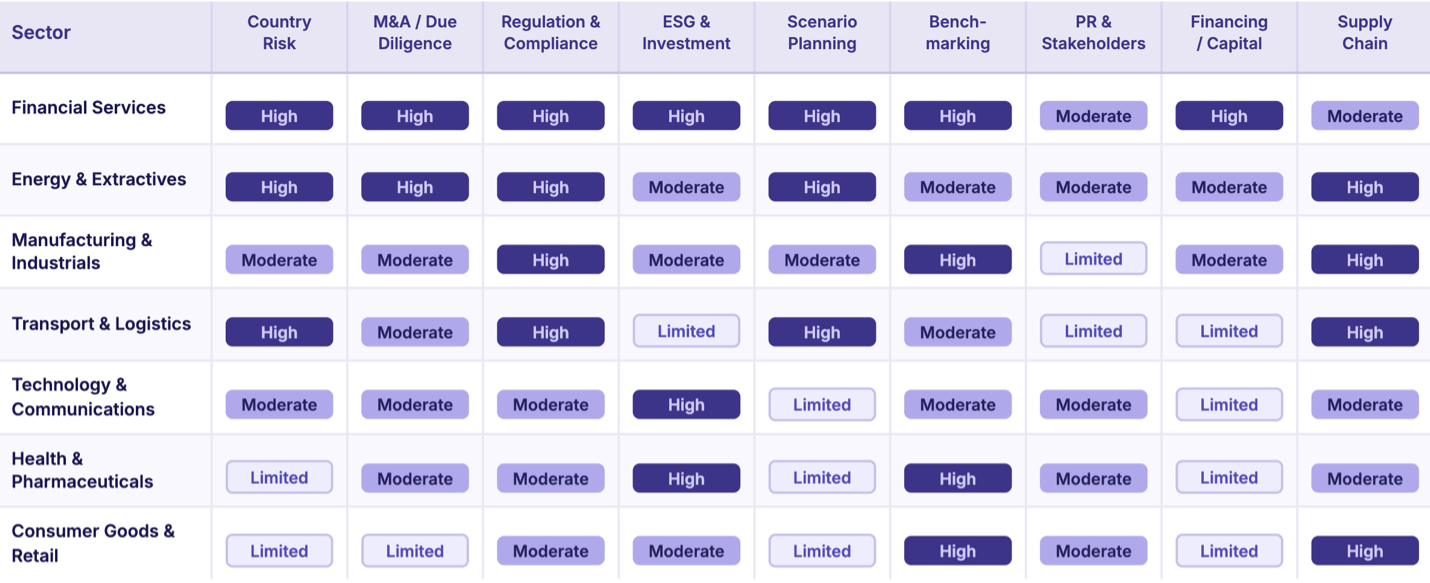
Rule of law data is increasingly becoming a strategic business asset. Different dimensions of the rule of law inform different corporate decisions—from assessing sovereign and investment risk to determining where to deploy capital, establish supply chains, negotiate partnerships, and expand into new markets. Financial institutions use indicators such as corruption, institutional checks and balances, and regulatory predictability to evaluate long-term country exposure, while energy, manufacturing, logistics, and technology companies rely on legal certainty, contract enforcement, and transparent regulation to safeguard operations and investments. Across sectors, the message is the same: companies are managing commercial risk while also managing institutional risk.
Comparative matrix: sector-level use of governance indicators across 26 multinational companies
The issue is not that companies fail to recognize the importance of rule of law. Overwhelmingly, they do. The challenge is that governance considerations are often embedded indirectly within broader ESG or geopolitical risk tools, making it harder for businesses to isolate the institutional drivers most relevant to them. Direct use of rule of law data offers companies the opportunity to move beyond generalized governance information toward more rigorous, evidence-based analysis of institutional risk which would enable better risk management, improve investment decisions and offer companies a competitive advantage in increasingly complex markets.
Leveraging globally recognized datasets, WJP is increasingly translating rule of law information into practical business intelligence that helps companies, investors, and public officials navigate an era of heightened legal, regulatory, and geopolitical uncertainty. From country and subnational diagnostics to targeted briefings and multi-stakeholder dialogues, WJP's existing methodologies allow it to respond quickly to evolving market disruptions while providing continuity and comparability over time.
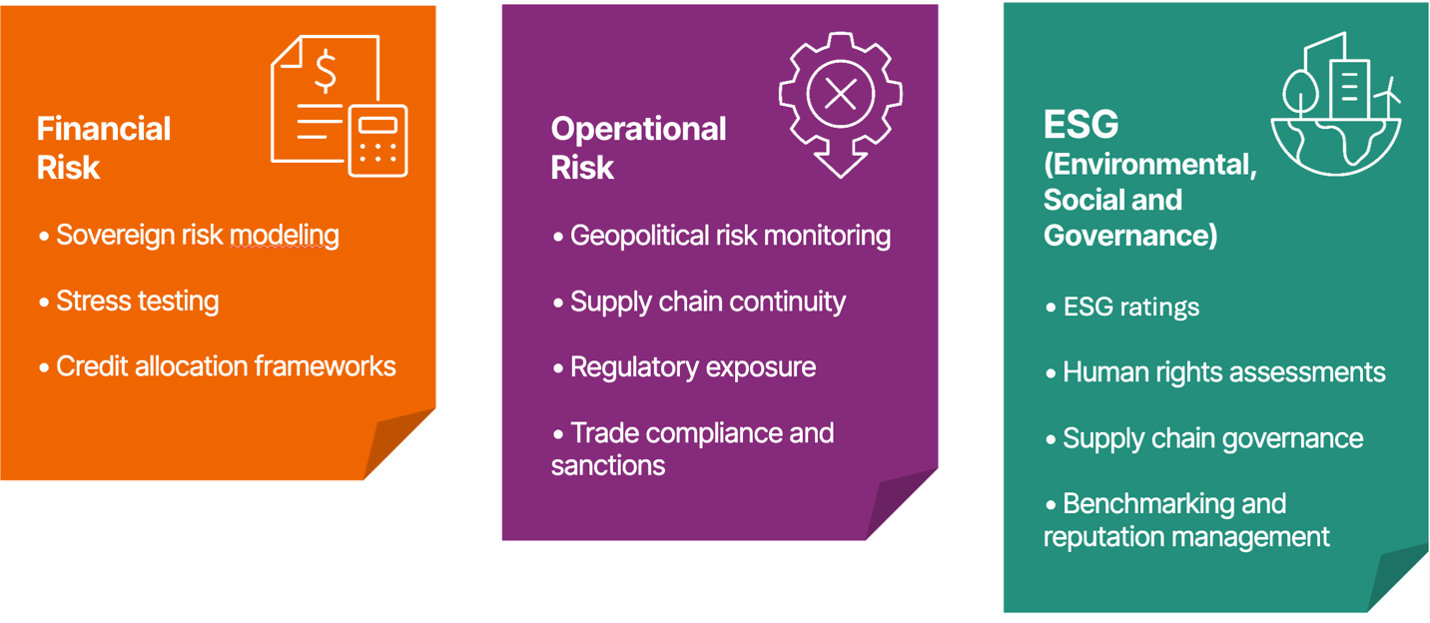
Governance data used in key operational areas to measure risk
Activating public-private collaboration through neutral convening
The need for more sophisticated governance analysis also reflects a broader reality: businesses cannot address rule of law risks alone.
Many of the challenges facing businesses today sit at the intersection of public and private action. Companies require not only better information but also trusted forums through which they can engage governments, legal leaders, and other stakeholders on issues that directly affect investment, competitiveness, and economic resilience. Governments, too, have a strong stake in this conversation: robust rule of law infrastructure is a key driver of economic competitiveness. Reliable data on legal certainty, regulatory quality, and institutional performance can help policymakers identify opportunities for investment, prioritize reforms, and demonstrate progress to domestic and international investors.
As an independent source of rule of law information, WJP has been able to serve as a neutral convener: bringing together business leaders, public officials, judges, bar associations, academics, and civil society organizations to foster constructive, evidence-based dialogue around shared economic and rule of law challenges. By grounding these conversations in data, WJP can help establish a common language for reform and create spaces for critical yet collaborative engagement between different sectors.
At WJP’s 2026 Asia Pacific Business Forum on the Rule of Law, held in Tokyo, senior corporate representatives, legal experts, and policy leaders from the region explored how legal certainty, institutional quality, and regulatory predictability underpin long-term investment and sustainable growth. Participants examined rule of law as a vital and strategic economic asset and discussed how businesses can better integrate governance considerations into risk management and decision-making.
Similarly, at a recent high-level meeting in Querétaro, Mexico, WJP convened state officials and business leaders from the technology, infrastructure, automotive, aeronautics, energy, and food production sectors to discuss findings from the WJP Mexico States Rule of Law Index. These discussions focused on how conditions influence operational and financial risks, ESG performance, and the attractiveness of jurisdictions for international investment. Participants emphasized that strong rule of law functions as the "invisible infrastructure" that enables markets to flourish by providing the certainty and predictability required for long-term growth.
Additionally, WJP is partnering with the Development Bank of Latin America and the Caribbean (CAF) to expand rule of law measurement across the region through an extended module on Complex Security and State Capacities in the WJP Rule of Law Index. This module will produce data on seven new thematic dimensions relevant to multi-level public security in up to 24 countries. The data will inform CAF’s strategies and operations, while providing governments and the private sector with deeper insights into the institutional conditions that shape investment, security and economic resilience.
Converting institutional risk into market opportunity
As companies increasingly compete in an environment defined not only by market dynamics but also by institutional performance, rule of law will become a core element of business intelligence. WJP's role is to ensure that businesses, investors and policymakers have the evidence needed to understand, measure and strengthen that institutional environment.
By combining original rule of law data with its convening power, WJP is helping translate data into action—enabling more informed decision-making, stronger public-private collaboration, and strengthening the institutional infrastructure that underpins resilient markets, long-term investment, and sustainable economic growth.
This Focus Note was written by our Senior Associate, Shallum David.
Footnotes
- World Economic Forum, The Global Risks Report 2026. Geneva, Switzerland. https://reports.weforum.org/docs/WEF_Global_Risks_Report_2026.pdf ↩
- World Justice Project, WJP Rule of Law Index 2025. Washington, DC, United States. https://worldjusticeproject.org/rule-of-law-index/insights ↩
- Elisabeth Braw, “Europe’s big advantage: Rule of law”, Politico, June 1, 2026, https://www.politico.eu/article/europes-business-advantage-rule-of-law/ ↩
- ESG reporting is the disclosure of environmental, social, and corporate governance data. This comprehensive approach allows companies to communicate their commitment to sustainability and responsible business practices to stakeholders, including investors, customers, and regulators. In certain jurisdictions, such as the European Union, it is obligatory for large companies and listed companies to publish regular reports on the social and environmental risks they face, and on how their activities impact people and the environment. ↩
- Transparency International, Corruption Perceptions Index 2025 (Berlin, Germany: Transparency International, 2026), https://www.transparency.org/en/cpi/2025 ↩
- International IDEA, The Global State of Democracy Indices, 2025 (Stockholm, Sweden: International IDEA, 2026), https://www.idea.int/democracytracker/gsod-indices/ ↩