
About Us

The WJP is an independent, multidisciplinary organization working to advance the rule of law worldwide.
Our Work

We engage advocates from across the globe and from multiple work disciplines to advance the rule of law.

Thailand has had positive milestones in privacy, personal security, and religious freedom. In contrast, a shrinking space for political expression has resulted in a "grand fatigue" among civil society actors. Justice and labor protections have come to function effectively for routine matters but fail vulnerable populations.
The findings come from WJP’s 2025 Human Rights in Thailand report, which integrates more than twenty indicators from the WJP Rule of Law Index, with expert insights that identify institutional drivers and practical barriers, contextualizing legal frameworks within their actual implementation on the ground.
Improving Freedoms with a “grand fatigue” in the civic space:
- Freedom from Interference with Privacy increased by 32% during the last decade.
- Freedom of Belief and Religion and Freedom of Assembly and Association have also continued to rise over the last five years, by 10% and 2% respectively.
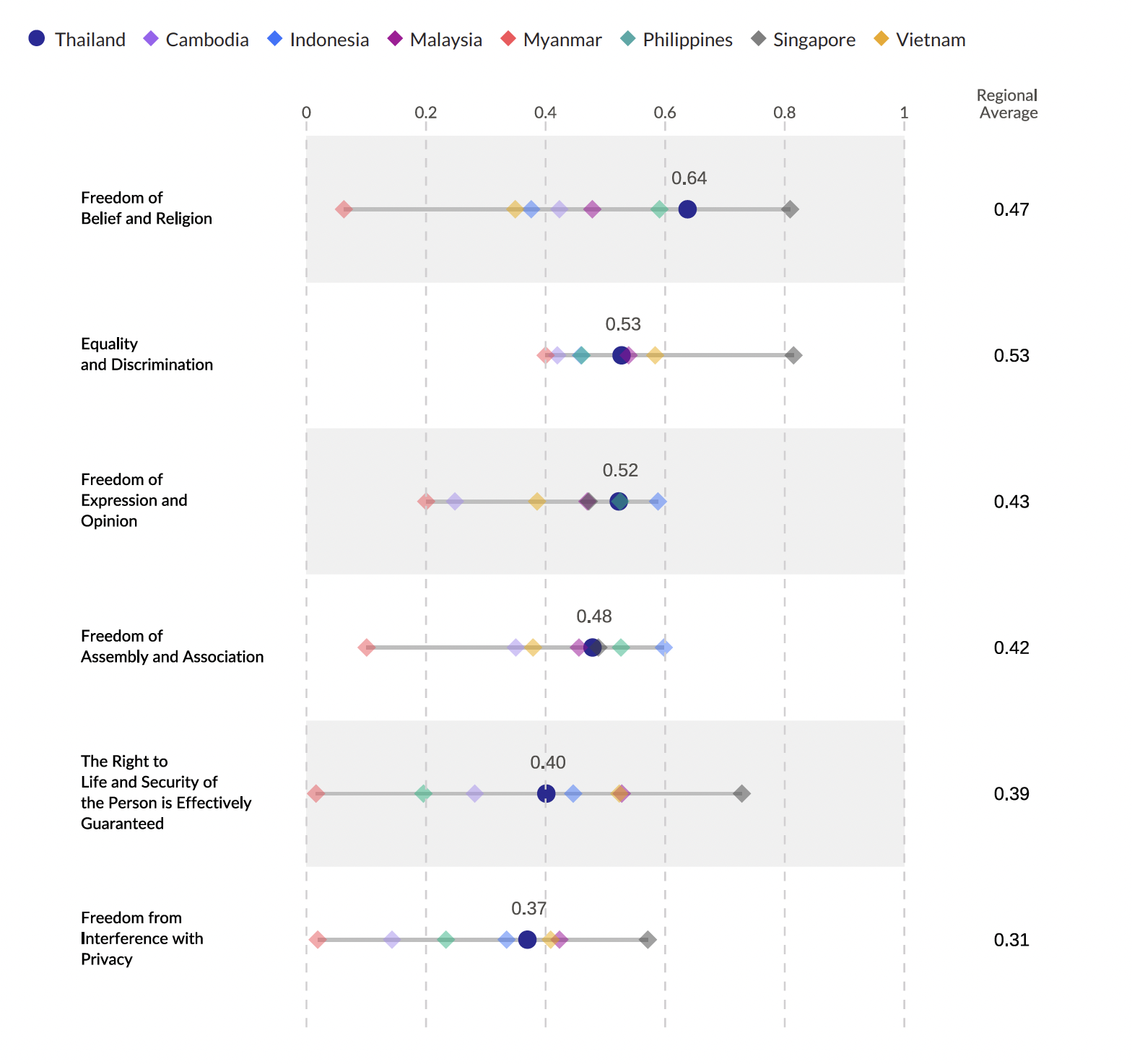
- Qualitative insights reveal that freedom of expression in Thailand is "topic-dependent". While social and economic issues are debated openly, speech concerning the monarchy (such as under Section 112) or the military triggers swift legal action, leading to severe self-censorship. Freedom of Expression and Opinion (-4%) declined in the most recent year.
- Indicators for civic participation and non-governmental checks on power have seen sustained downward trends over the past decade.
"It's not that they don't care. It's not that they don't want to criticize. It's that they have come to realize that there's no point, that change is impossible. So there's a grand fatigue."
-
A lack of genuine accountability in public consultations has resulted in "grand fatigue" among activists. For many, the realization that structural change remains blocked by judicial and administrative mechanisms has transformed their civic energy into a state of "Grand Fatigue"—a skepticism where participation is seen as futile because the system appears designed to absorb or reverse its effects.
A "Two-Speed" Justice System:
- Criminal justice indicators on a high: Due process of the law, impartiality, and freedom from improper government influence in criminal justice—reached their highest levels in a decade.
- Civil justice indicators at an all-time low: Due process in administrative proceedings and administrative proceedings without unreasonable delay, sank to decade-lows.
-
Thailand operates a "two-speed" justice system according to interviews with local experts: routine cases are adjudicated efficiently, but politically sensitive cases face restrictive bail practices, prolonged pre-trial detention, and hierarchical pressures on judges.
Economic Rights & Thailand’s Labor Court
- Thailand’s Labor Court is considered among the most effective judicial forums. Proceedings are free for workers, and legal assistance is available at no cost. Experts also noted the importance of mediation in labor cases.
"Back in the days, you'd see construction sites, guys wearing flip-flops, shirtless, with no head protection. Those are days of the past, and these are strictly enforced now.”
- However, while formal sector workers benefit from a highly functional Labor Court, millions of undocumented migrant workers are systematically excluded from these protections due to language barriers and fears of deportation.
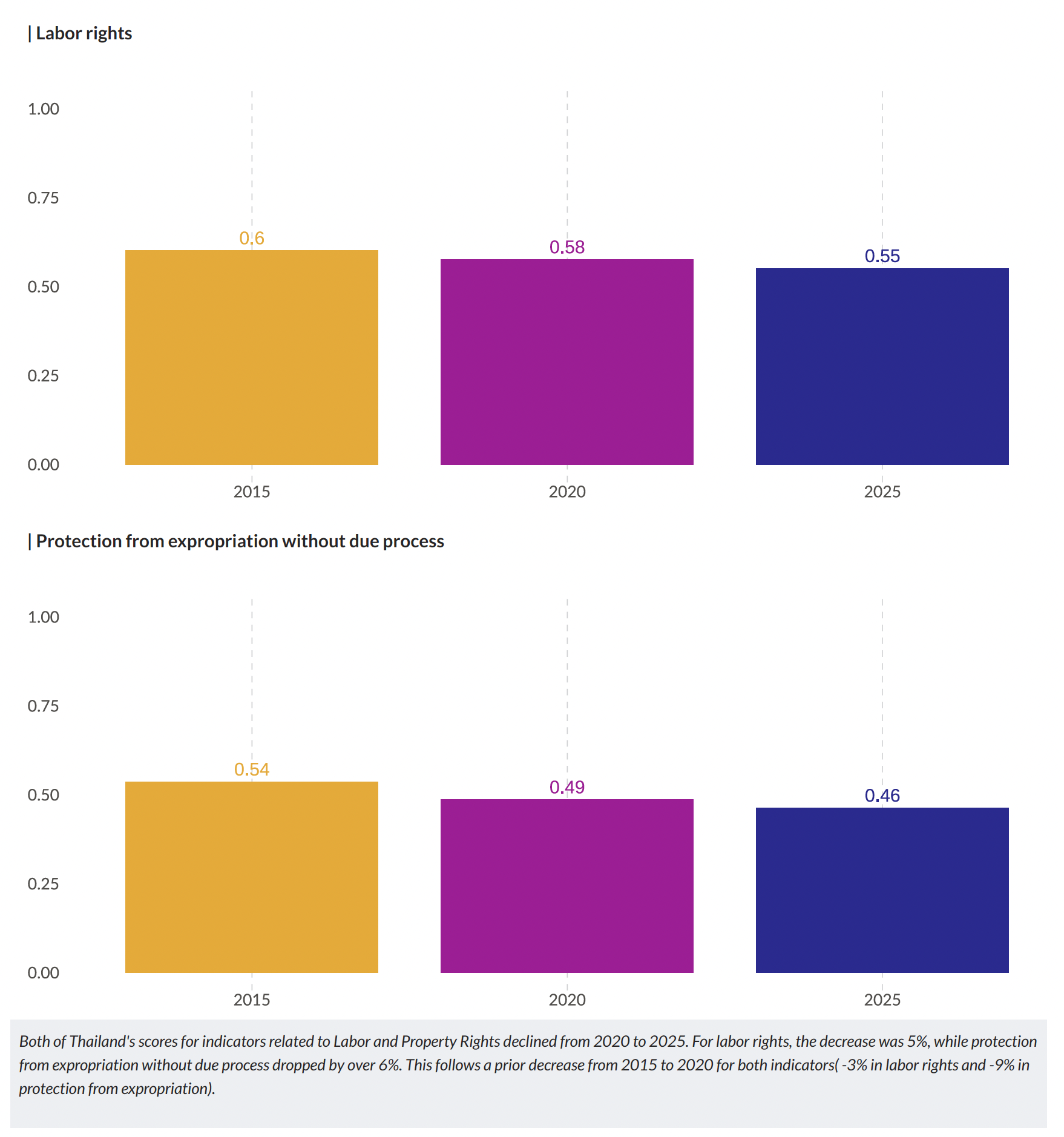
- Protections for workers and property owners continue to erode. Between 2020 and 2025, labor rights fell by 5%, and protection from expropriation without due process by 6%.