

About Us

The WJP is an independent, multidisciplinary organization working to advance the rule of law worldwide.
Our Work

We engage advocates from across the globe and from multiple work disciplines to advance the rule of law.

WJP Rule of Law Index data reveals why legal reforms must be measured by ground-level outcomes, featuring Moldova's EU accession case study.
The rule of law is the business model of a democratic society and a resilient economy. The World Justice Project (WJP) research shows that strong adherence to the rule of law is associated with higher economic growth, better education, greater peace, and longer life expectancy.[1] The rule of law constrains the arbitrary exercise and concentration of power, protects human rights, supports independent and impartial dispute resolution, combats corruption, and creates a fair and predictable framework for economic activity. These safeguards are even more important as the ways in which power is accumulated and exercised are changing, including as a result of rapid technological developments. In its updated Rule of Law Checklist, the Venice Commission acknowledges this shift by noting that rule of law requirements should also apply to private actors when they perform public functions or exercise powers comparable in their impact to those of public authorities.[2]
Measuring Rule of Law Impact in the European Union
For the European Union (EU), the rule of law is both a founding value and a fundamental requirement for membership.[3] Over the past decade, the EU has developed a comprehensive framework to monitor and support the rule of law across its Member States and candidate countries, including through the annual Rule of Law Reports and the enlargement process. The issue is no longer what countries have committed to change, but what impact the reforms they have adopted are actually having in practice. Evaluating reform requires moving beyond legislative outputs. To measure real-world impact, stakeholders must assess:
- Judicial Efficacy: Are court backlogs decreasing, and are civil judgments reliably enforced?
- Regulatory Predictability: Are administrative decisions transparent, objective, and timely?
- Public Oversight: Are public authorities and influential private actors subject to effective oversight and accountability?
- Rights Protection: Can businesses and individuals consistently protect their legal interests without facing arbitrary barriers?
Finding accurate answers to these questions requires a holistic approach that is not limited to analyzing adopted laws or institutions that have been established. It is also important to understand how people and businesses experience and perceive those changes in their daily lives and activities. Independent, people-centered data provides valuable insights in this respect. The challenge is then to connect rule of law agendas more systematically with evidence of outcomes.
European Rule of Law Trends
The global rule of law recession continued to accelerate in 2025.[4] In total, 68% of countries declined, compared with 57% the year before. In Europe, regional averages do not show the same broad deterioration.
The EU remains a global leader in the rule of law. Eight of the ten countries with the highest scores in the 2025 WJP Rule of Law Index® are EU Member States. The EU average has remained broadly stable over the past decade. However, between 2024 and 2025, the EU average declined slightly, due to lower overall scores in several countries, including Hungary, Bulgaria, Greece, Portugal, Slovakia, and Slovenia. Enlargement countries score below the EU average, but their overall performance has also stayed relatively steady over time. Between 2024 and 2025, half experienced slight declines.
Globally, the decline in the rule of law in 2025 was largely driven by weakening constraints on government powers, declining open government, erosion of fundamental rights, and worsening civil justice. The EU and enlargement countries did not show the same broad deterioration across these areas in 2025. Over the last year:
- Overall performance on fundamental rights remained unchanged from 2024 in both groups, averaging 0.76 in the EU and 0.57 in the enlargement countries.
- Constraints on government powers were also unchanged.
- Open government and civil justice remained stable in the EU but declined slightly in the enlargement countries.
Between 2015 and 2025, average scores for constraints on government powers, open government, and civil justice declined slightly in both groups, with somewhat larger declines in the enlargement countries.
WJP Index regional averages are useful for identifying broader trends, but they do not always capture important changes in the rule of law within a country. To understand these changes, it is necessary to look at the underlying factors and sub-factors at the country level. They show areas of strength and weakness, as well as where progress has been made, both in the past year and over the longer term.
Case Study: Moldova’s EU Accession and Rule of Law Performance
Moldova is an interesting case study. An EU candidate since 2022 and in accession negotiations since 2024, the country completed bilateral screening in 2025 and opened negotiations on the Fundamentals cluster in 2026. The EU has recognized Moldova’s reform achievements, with President von der Leyen noting that the country had completed 93% of the reforms due under the EU Growth Plan.[5] At the same time, progress on the Fundamentals cluster, which covers judiciary, anti-corruption, fundamental rights, and other areas central to the rule of law, will determine the overall pace of Moldova’s accession. People-centered data can show how the rule of law functions in practice as these reforms move forward.
According to the WJP 2025 Rule of Law Index®:
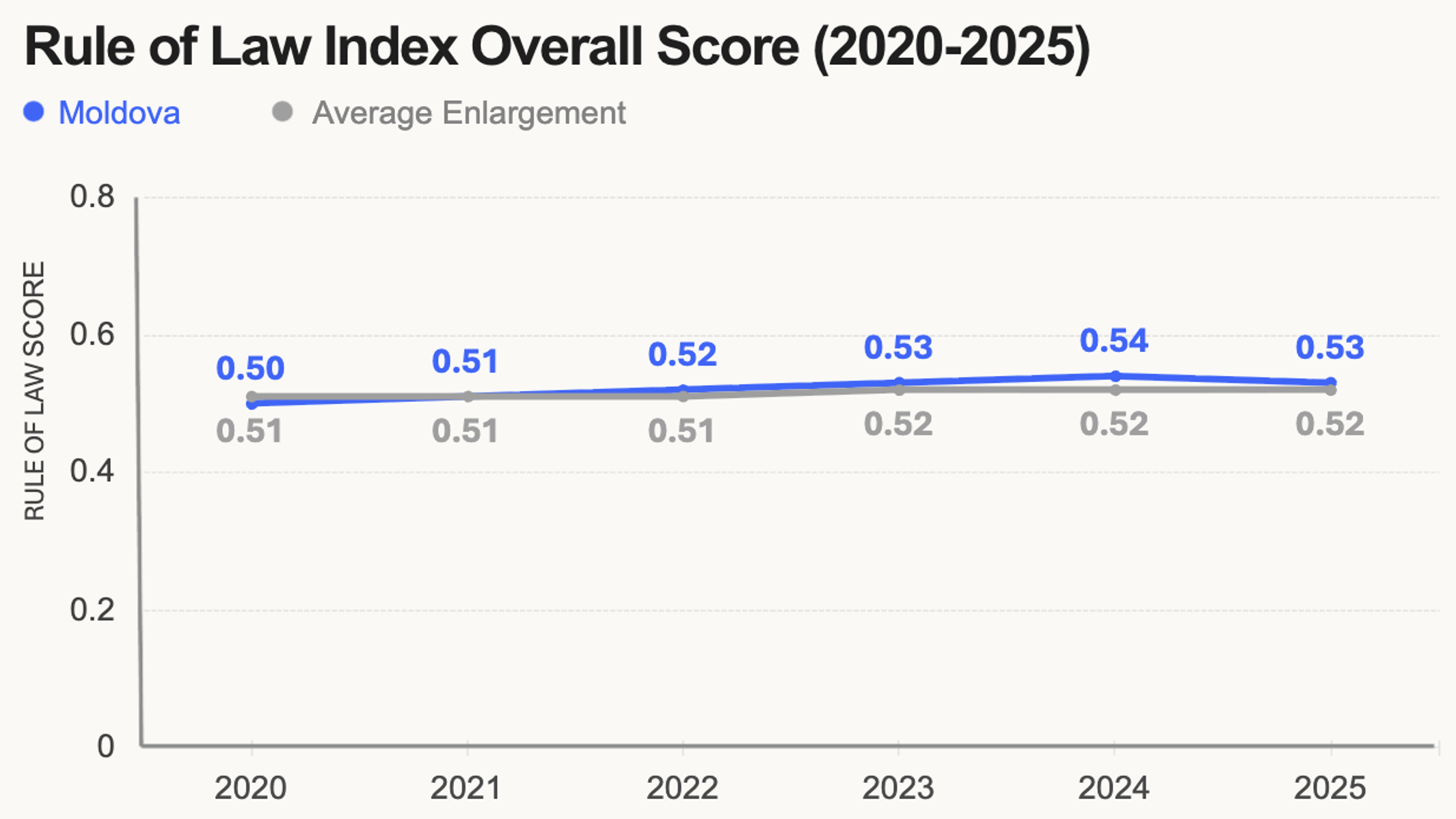
- Moldova’s overall rule of law score has improved since 2020 and has remained above the enlargement country average since 2021.
- Fundamental rights remain above their 2020 level, and criminal justice has improved.
- Several checks on government power have also strengthened.
Nevertheless, the data continue to show weaknesses in addressing corruption, holding public officials accountable for misconduct, and the effectiveness of the justice system.
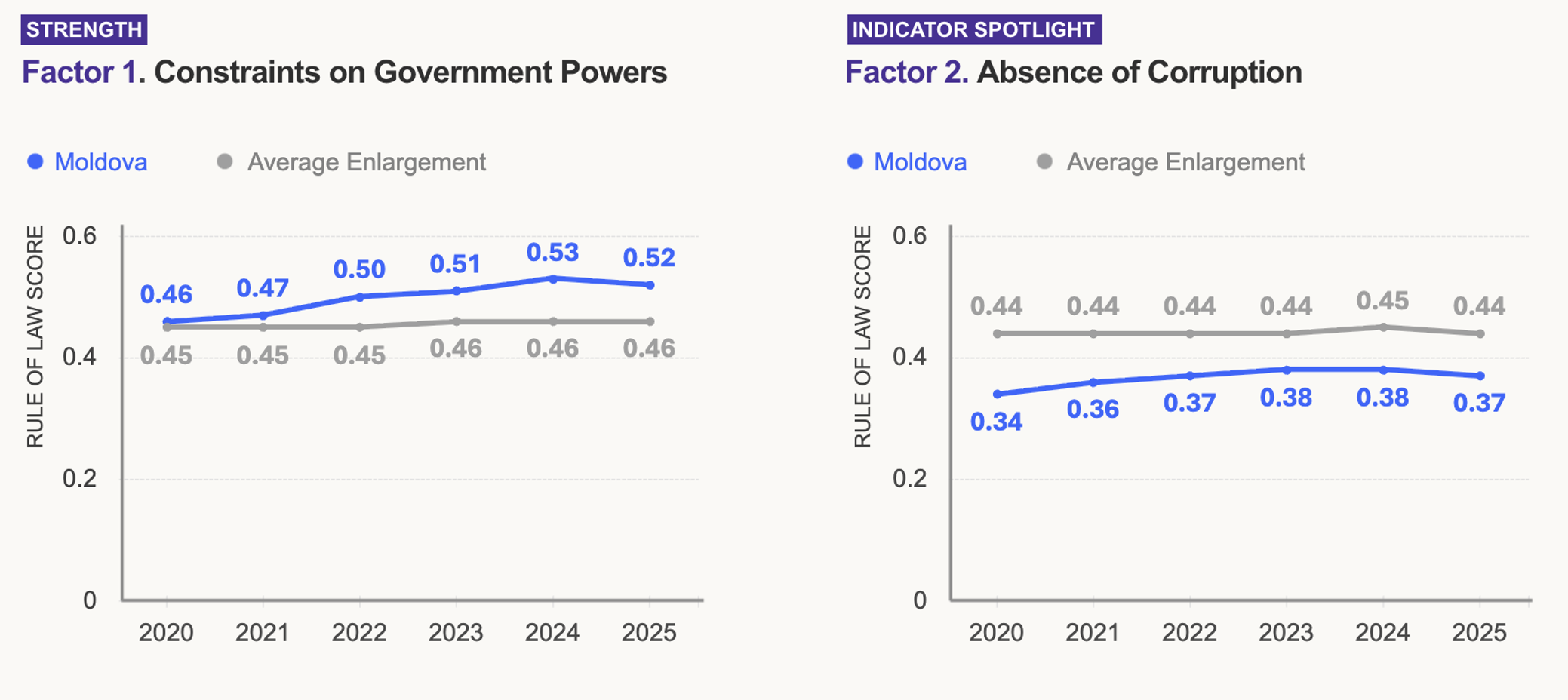
- Checks and balances: Constraints on government powers have generally strengthened since 2020. Moldova’s score increased from 0.46 in 2020 to 0.53 in 2024, before slightly falling to 0.52 in 2025. The latest decline came mainly from weaker legislative checks and safeguards for lawful transfers of power. Despite this, both remain among Moldova’s strongest-performing areas and have improved considerably since 2020. Judicial constraints on government power have improved over the ten-year period, but declined slightly in 2025 and remain among the lower-performing areas. Sanctions for official misconduct are also weak.
- Anticorruption challenges: Moldova continues to face challenges in combating corruption. Its absence of corruption score has improved since 2020, although it declined slightly in 2025. The legislative branch continues to be the weakest area, which indicates persistent risks of misuse of public office for private gain. The judicial branch showed the largest decline in 2025 (from 0.46 to 0.43), partly offsetting gains made over the previous four years and raising concerns about integrity and freedom from improper influence in the judiciary. On the other hand, the police and the military continue to perform better.
- Regulatory enforcement can improve: Regulatory enforcement has improved over the long term (from 0.41 in 2015 to 0.46 in 2025), but progress has leveled off in recent years. Government regulations are now enforced more effectively than they were a decade ago, and due process in administrative proceedings has also improved, although it remains a relatively weak area (0.34). At the same time, the score for regulations being applied and enforced without improper influence remains below its 2015 level. Administrative proceedings have become somewhat less timely since 2023. Uncertainty over how regulations will be applied and how long administrative decisions will take can make it harder for businesses to plan and operate.
- Fundamental Rights: In 2025, Moldova’s overall performance on fundamental rights remained stable (0.61). The strongest areas continue to be the right to life and security of the person, freedom of belief and religion, and freedom of assembly and association. Over the five-year period, due process of law and rights of the accused show the most improvement (0.44 in 2020 to 0.53 in 2025), although it remains among the lower-performing areas.
- Civil and Criminal Justice: Conversely, Moldova’s overall score on civil justice declined slightly in 2025. The change was mainly linked to weaker enforcement of civil court judgments, indicating difficulties with the timely and consistent implementation of decisions. Access to civil justice and freedom from discrimination have improved. At the same time, delays continue to be a problem, with timeliness declining from 0.48 in 2020 to 0.40 in 2025. Civil justice is also affected by corruption (0.34) and improper government influence (0.40), which continue to limit the effective resolution of disputes.
Criminal justice has improved since 2020. Moldova has made gains in due process, impartiality, and freedom from improper government influence. Freedom from improper government influence shows one of the largest changes, with the score rising from 0.20 in 2020 to 0.40 in 2025. Yet effective criminal investigations remain the weakest aspect of the criminal justice system, and corruption continues to affect its performance.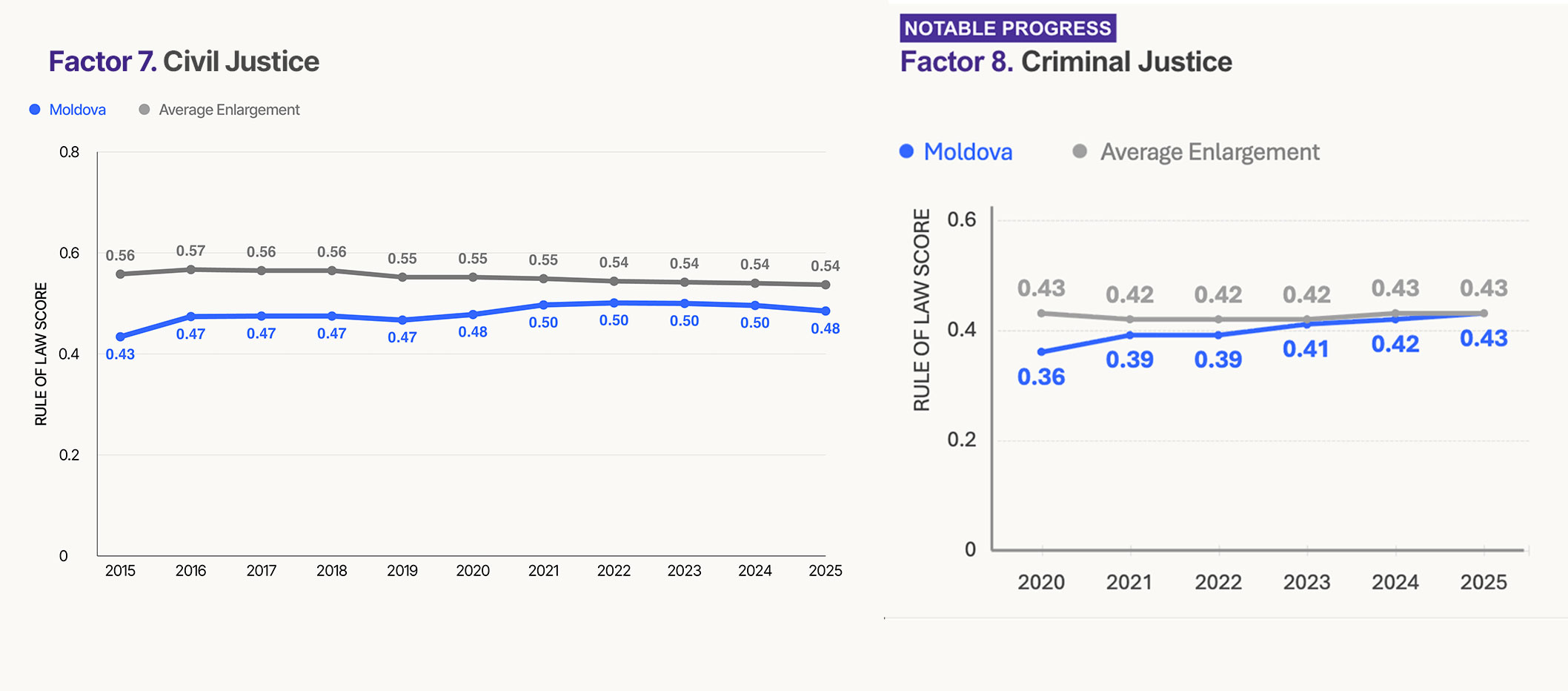
Connecting Institutional Monitoring with Ground-Level Evidence
The WJP Rule of Law Index® findings provide evidence of how the rule of law is experienced and perceived in practice and how conditions are changing over time. As Moldova illustrates, an improvement in the overall performance does not necessarily mean that progress is uniform. Some areas have improved, while others have remained stable or declined slightly. Drawing on the experiences of the general population and assessments by legal experts, WJP Rule of Law Index® data help identify these different trends. The data can’t, on their own, establish whether a certain reform caused these changes. However, they can show whether performance is improving in the areas those reforms are intended to address. Assessing the results of reforms also requires evidence on what measures were adopted and how they were implemented.
WJP data complements legal and institutional assessments. While those assessments examine laws, institutions, reform commitments, and their implementation, WJP provides user-centered evidence on how different areas of the rule of law are functioning in practice. In Moldova, for instance, relevant sources include the European Commission’s Moldova Report 2025, Moldova’s Cluster 1 negotiating position, including the commitments under Chapters 23 and 24; the National Programme for the Accession of the Republic of Moldova to the EU 2025-2029; government monitoring of the implementation of the Justice Sector Strategy; relevant Council of Europe assessments and the OECD’s 2026 Justice Review; and independent monitoring and analysis by leading civil society organizations, including the Institute for European Policies and Reforms (IPRE) and the Legal Resources Centre from Moldova (LRCM). By looking at all of these sources together, policymakers and other stakeholders have a stronger basis for decision-making, as they can better assess if reforms are leading to better rule of law outcomes and what further actions are needed.
These questions will also inform discussions at the Annual EU Enlargement Conference “The 2026 Enlargement Package: Advancing EU accession negotiations through reforms, dialogue, transparency and social cohesion”, in November 2026 in Moldova. Organized by the Bureau for European Integration, IPRE, the Friedrich-Ebert-Stiftung (FES), and other Moldovan and international partners, including WJP, the conference will examine progress in Moldova’s accession process and reforms still ahead.
- What is the Rule of Law?, World Justice Project, available at: https://tinyurl.com/3v6fj5w6 ↩
- European Commission for Democracy through Law (Venice Commission), The Updated Rule of Law Checklist, CDL-AD(2025)002-e, 2025, pp.6, 8-9, 24. ↩
- Articles 2 and 49 of the Treaty on European Union (TEU). ↩
- WJP Rule of Law Index® 2025. ↩
- European Commission, “Statement by President von der Leyen following the EU-Moldova Summit”, 22 June 2026, available at: https://enlargement.ec.europa.eu/news/statement-president-von-der-leyen-following-eu-moldova-summit-2026-06-22_en ↩