
About Us

The WJP is an independent, multidisciplinary organization working to advance the rule of law worldwide.
Our Work

We engage advocates from across the globe and from multiple work disciplines to advance the rule of law.
On March 26th, the World Justice Project (WJP) will launch the WJP Open Government Index™ 2015, the first effort to measure government openness based on the general public’s perspective. The Index uses four dimensions to measure government openness: publicized laws and government data, right to information, civic participation, and complaint mechanisms.
The WJP Open Government Index examines practical, everyday situations, such as whether people can receive public information when they request it, and whether people can raise their voice and participate in decision-making processes. Ranks and scores are derived from more than 100,000 household surveys and in-country expert questionnaires, covering a total of 102 countries and jurisdictions.
In addition to scores and rankings, the WJP Open Government Index 2015 tracks the experiences of ordinary people as they request information from the government, showing country-specific gender and socio-economic breakouts to selected survey answers. An accompanying report will also provide global insights on the relationship between open government and other aspects of governance and development, such as participation in the Open Government Partnership, gender equality, and economic development.
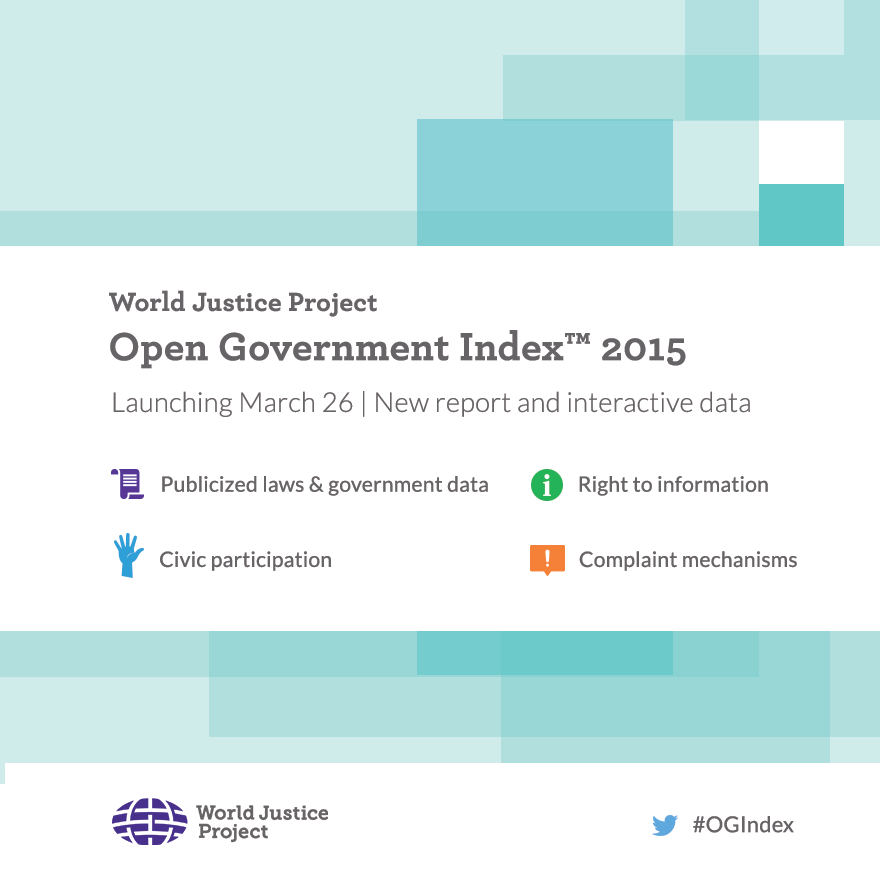
The WJP Open Government Index 2015 is a product of two years of development, consultation, and vetting with policy makers, civil society groups, and academics from several countries. It is our hope that over time this diagnostic tool will help identify strengths and weaknesses in the countries under review and encourage policy choices that enhance openness, promote effective public oversight, and increase public and private sector collaboration.
Stay tuned to our website and the social media hashtag #OGIndex on launch day for the downloadable report, an interactive data website, and infographics to share with your networks.
Please direct media requests to: [email protected]