
About Us

The WJP is an independent, multidisciplinary organization working to advance the rule of law worldwide.
Our Work

We engage advocates from across the globe and from multiple work disciplines to advance the rule of law.
MEDIA CONTACT: Natalia Jardon | [email protected]
Authoritarianism is entrenched, WJP Index Finds
No longer an emerging trend in the majority of countries, with rising government interference and rollbacks in freedom of speech and participation.
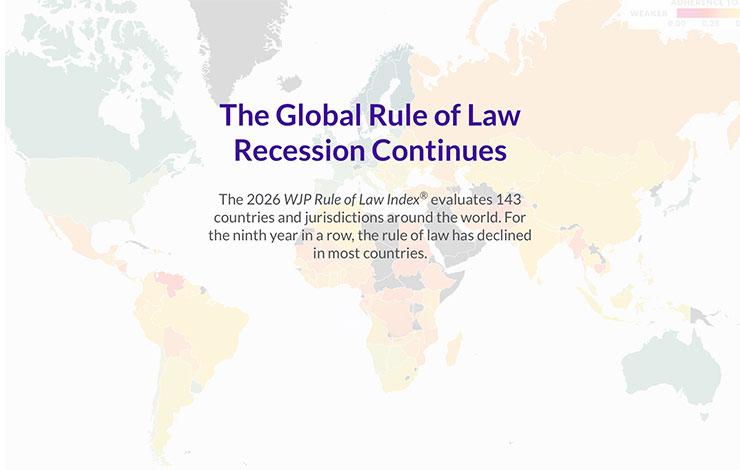
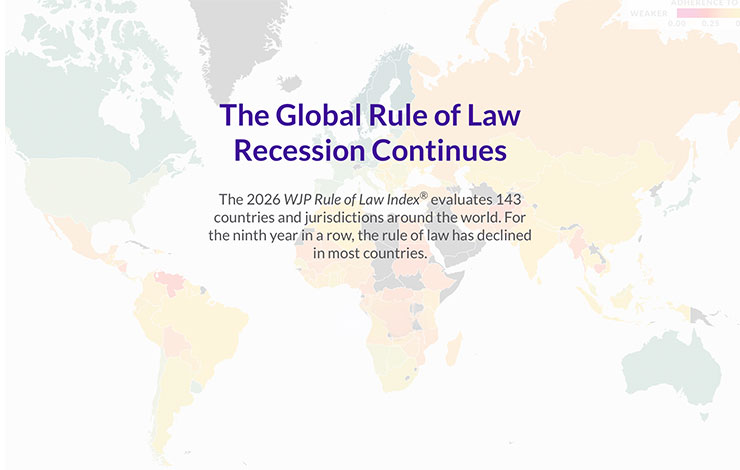
WASHINGTON (October 21, 2026) – The global rule of law recession persists, according to the new WJP Rule of Law Index® 2026, released today by the World Justice Project (WJP). While fewer countries declined this year compared to last, the global balance remains deeply uneven. Declines continue to outnumber improvements for the ninth consecutive year (62% vs. 38%).
The WJP Rule of Law Index is the world’s leading source of original, independent rule of law data, covering 143 countries and jurisdictions.
“This year’s findings demand urgent attention. Over 86% of countries have suffered a sustained five-year decline in at least one safeguard against authoritarian rule: constraints on government powers, open government, or fundamental rights. Authoritarianism is no longer merely an emerging trend — it has become entrenched in many parts of the world,” said Alejandro Ponce, WJP’s Executive Director.
Speaking of the rule of law as a core economic asset, he added: “Beyond its impact on governance, weak rule of law poses a direct threat to the private sector: when institutions falter, market confidence breaks down.”
Avenues for civic space are narrowing
An expansion of authoritarian practices — namely a constriction of civic space and weakening of checks and balances — remains the primary force behind this downturn:
- Declines in Constraints on Government Powers were driven by deteriorations in non-governmental checks, limits by the judiciary, and lawful transitions of power.
- Restrictions in Open Government were caused by rollbacks in civic participation and the right to information.
- Fundamental Rights deteriorated amid mounting restrictions on freedoms of speech, assembly, and association.
Freedoms essential to civic space, public debate, and government oversight are shrinking across most countries:
- Freedom of opinion and expression fell in 64% of countries.
- Freedom of assembly and association fell in 67%.
- Civic participation fell in 65%.
Government interference is compromising the justice system
Across criminal and civil systems alike, undue executive pressure and interference have become the leading drivers of institutional decay. Civil justice weakened in 64% of countries and criminal justice in 58%, with improper government influence emerging as a central factor in both areas. Judiciaries are also losing ground to executive overreach more broadly: judicial limits on government powers declined in 63% of countries.
Prosperous nations share a foundation in the rule of law
Index data shows that economic prosperity, price stability, and low credit risk cluster in countries with robust rule of law:
- GDP per capita: Countries with a GDP per capita above the world's average ($14,406) score 0.68 or higher in the WJP Rule of Law Index.
- Inflation: Countries with inflation rates lower than the median (3.23%) have an Index score of 0.60 or above.
- Sovereign credit ratings: Countries with an investment-grade sovereign credit rating (AAA to BBB) maintain Index scores of 0.66 or higher.
WJP Rule of Law Index 2026: Global Highlights
The WJP Rule of Law Index provides data on eight factors: Constraints on Government Powers, Absence of Corruption, Open Government, Fundamental Rights, Order and Security, Regulatory Enforcement, Civil Justice, and Criminal Justice. Scores range from 0 to 1, where 1 signifies the highest possible adherence to the rule of law. This year, the Index covers 143 countries and jurisdictions.
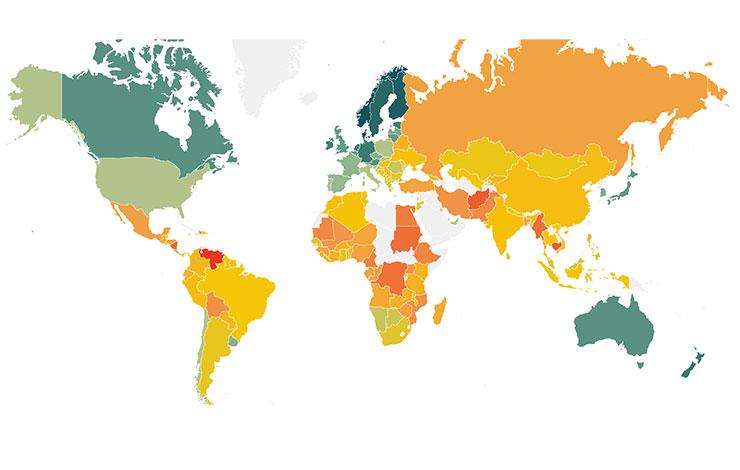
- Top-Ranked Countries: Denmark (1), Norway (2), Finland (3), Sweden (4), Luxembourg (5).
- Bottom-Ranked Countries: Venezuela (143), Afghanistan (142), Haiti (141), Cambodia (140), Nicaragua (139).
- Largest Declines: The most significant decliners include Haiti (-5.6%), Tanzania (-3.5%), and Sudan (-2.8%).
- Largest Improvements: Countries with the largest improvements include Latvia (1.6%), Trinidad and Tobago (1.2%), and Guatemala (1.1%).
Explore the full rankings and findings of the 2026 WJP Rule of Law Index at: http://www.worldjusticeproject.org/index/
###
- Find graphics (global rankings, regional/income group rankings, and comparative maps) here.
- Find all 143 country press releases organized by region here.
About the WJP Rule of Law Index:
The World Justice Project (WJP) Rule of Law Index® is the world’s leading source for original, independent rule of law data. Its rigorous methodology draws on expert and household surveys to measure the rule of law in 143 countries and jurisdictions, covering 95% of the world’s population.
The Index relies on more than 215,000 household surveys and 3,400 legal practitioner and expert surveys to measure how the rule of law is experienced and perceived worldwide. Published annually since 2009, the Index is used by governments, multilateral organizations, businesses, academia, media, and civil society organizations.
About the World Justice Project:
The World Justice Project (WJP) is an independent, nonpartisan, multidisciplinary organization working to create knowledge, build awareness, and stimulate action to advance the rule of law worldwide.