

About Us

The WJP is an independent, multidisciplinary organization working to advance the rule of law worldwide.
Our Work

We engage advocates from across the globe and from multiple work disciplines to advance the rule of law.

Discover how the rule of law relates to economic prosperity, GDP growth, inflation, and sovereign credit risk based on 2026 WJP Index data.
We hear about the rule of law in the news every day, but what exactly is it, and how does it affect our daily lives?
At its heart, the rule of law means power must answer to the law, no matter who holds it. It means that political power has limits. Public officials must serve the public, not themselves. Police and security forces must protect people, not intimidate them. And it means that economic power has limits. Businesses should be able to compete, innovate, and grow — but on fair terms. And it means that coercive power has limits.
How is the rule of law connected to economic prosperity?
Key economic outcomes, including growth and price stability, are dependent on healthy and functional rule of law systems. For example, upholding contractual obligations, protecting property rights, and ensuring the timeliness of administrative proceedings have implications for the ability to maintain a stable and predictable business environment. In this sense, the rule of law is an economic asset: it provides the institutional foundation for sustainable development while influencing how businesses assess risk, make investment decisions, and pursue opportunities.
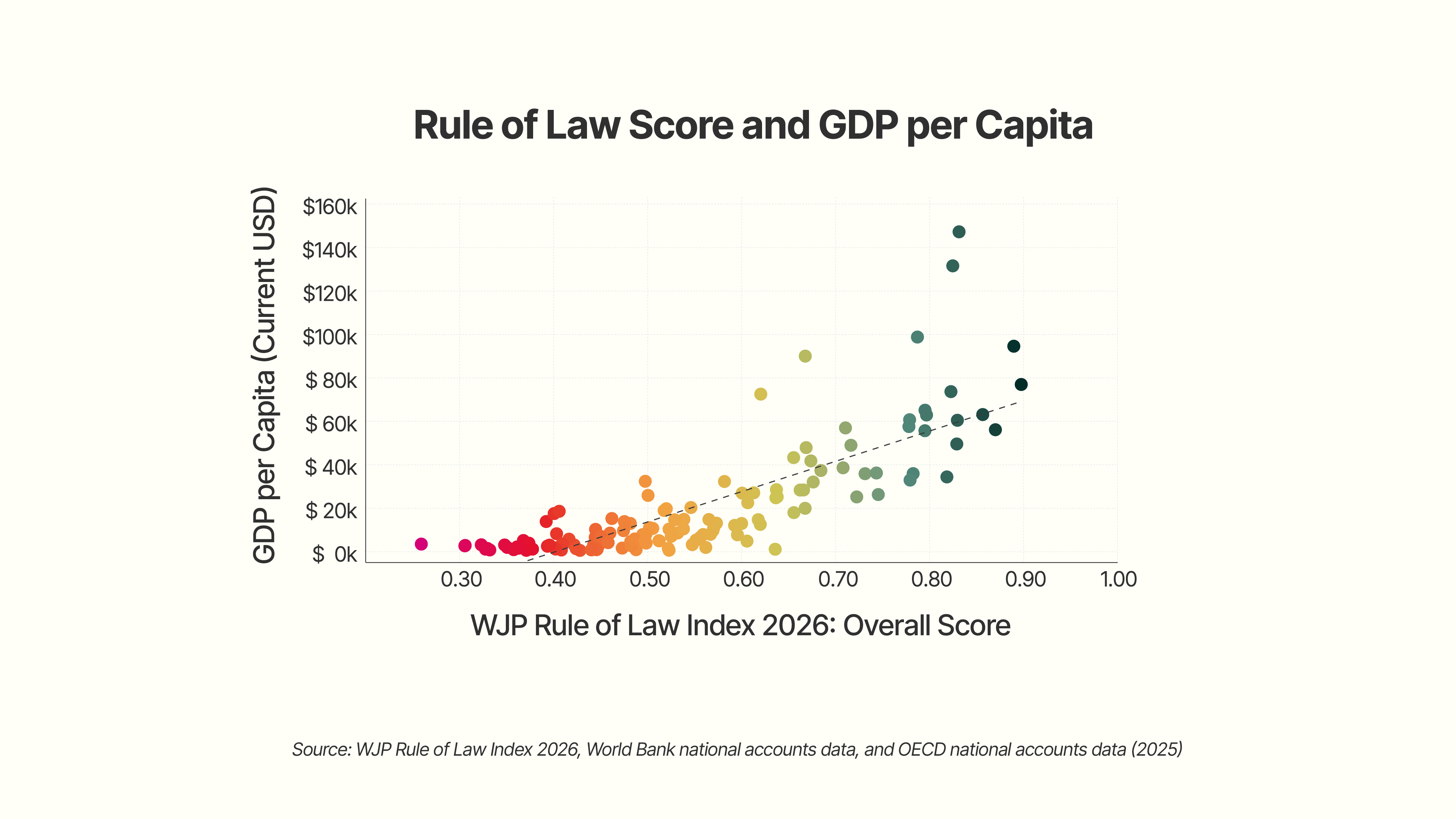
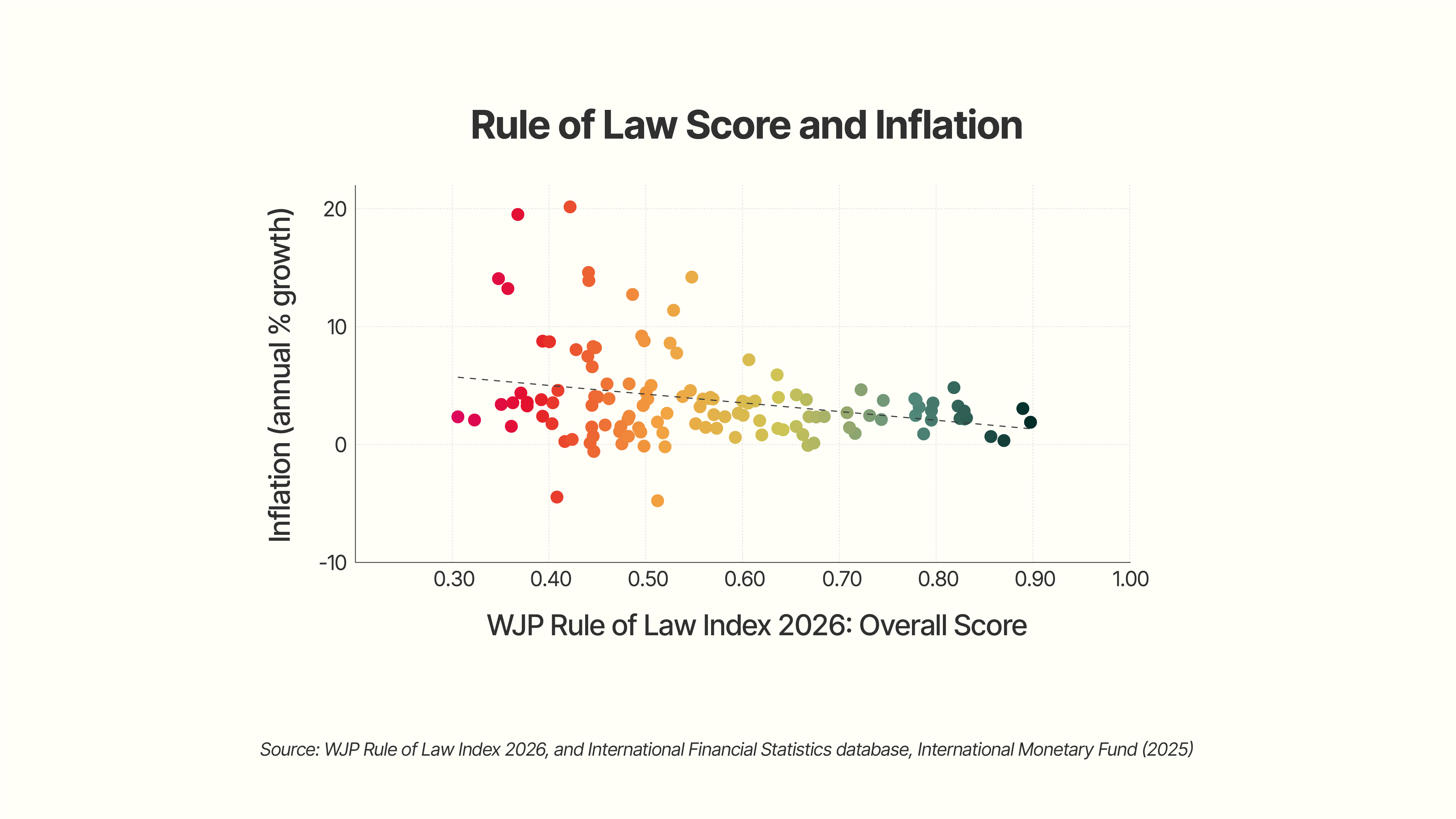
Data from the 2026 WJP Rule of Law Index® reinforces this relationship, as it reveals a positive correlation between stronger adherence to the rule of law and higher levels of economic prosperity (Figure 1) as well as greater price stability (Figure 2). In fact, countries with a GDP per capita above the global average1 have an average WJP Rule of Law Index score of 0.68 – 13 points higher than the global average for 20262. Similarly, the Index data shows a negative relation between inflation rates and WJP Rule of Law Index scores (Figure 2). Countries with inflation rates below 3%3 tend to perform better on rule of law indicators, highlighting the relationship between stronger institutions and greater price stability.
Beyond macroeconomic indicators, the rule of law also plays a fundamental role in shaping how markets function and how businesses operate on a day-to-day basis. Judicial independence and effective anti-corruption safeguards help create a climate in which businesses can assess risks, attract investment, and pursue new opportunities.
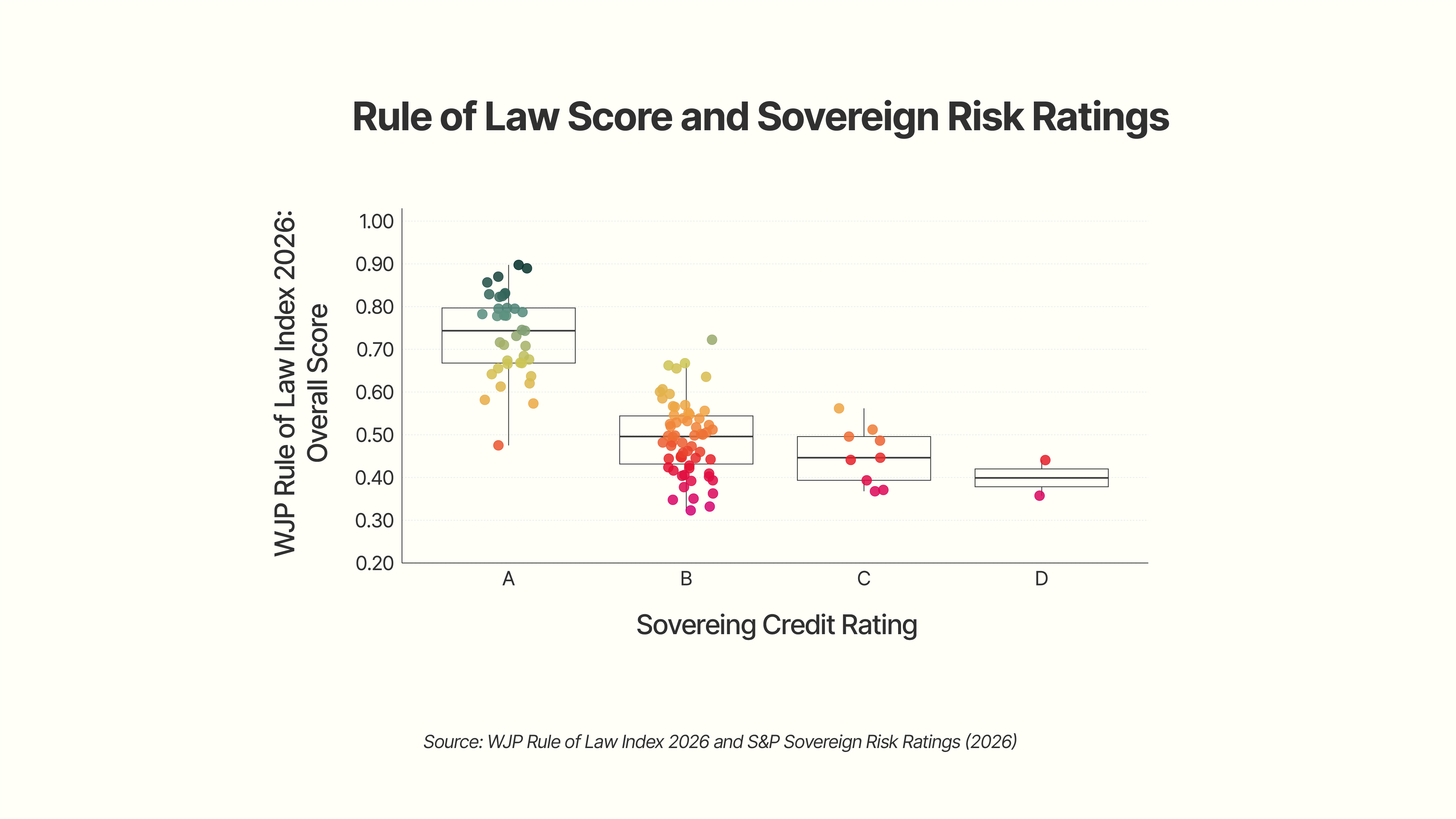
Investors and businesses evaluate economic opportunities not only based on a country's wealth and price stability, but also by considering broader risks. One important measure is sovereign credit risk, which reflects a government's ability and willingness to meet its financial obligations. The 2026 WJP Rule of Law Index data indicates that countries with stronger adherence to the rule of law tend to receive higher sovereign credit ratings (Figure 3). This relationship highlights the importance of strong institutions in fostering a stable business environment. When rules are transparent, consistently enforced, and applied equally to all, businesses gain the certainty needed to make investment decisions and plan for the long term.
Ultimately, the rule of law is more than a legal or political principle—it is the backbone of economic opportunity. Index data demonstrates that strong legal protections directly correlate with price stability, lower sovereign credit risk, and wealth, proving that sound governance is essential for lasting economic resilience. By strengthening institutions, promoting stability, and creating a predictable environment for businesses and investors, the rule of law helps lay the groundwork for more resilient, inclusive, and prosperous economies.
1 According to the World Bank, the world’s GDP per capita in current USD for 2025 is $14,405 for 2025.