

About Us

The WJP is an independent, multidisciplinary organization working to advance the rule of law worldwide.
Our Work

We engage advocates from across the globe and from multiple work disciplines to advance the rule of law.

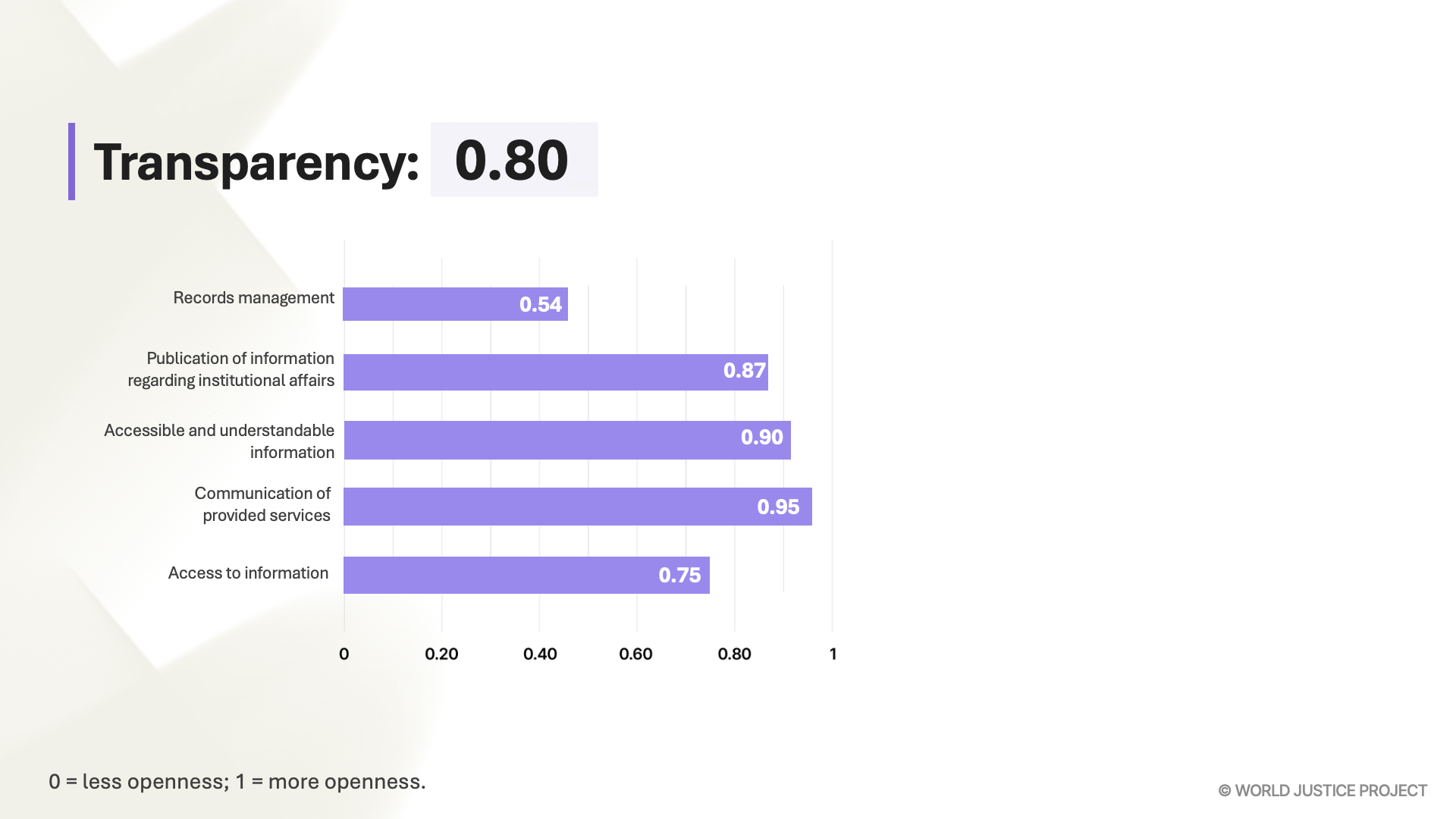
While justice institutions in the Dominican Republic have mostly consolidated transparency practices, there is still room for improvement regarding accountability, participation, and collaborative practices.
These findings come from the Dominican Republic Open Justice Metric (DR-OJM), which analyzes, through 73 indicators, the institutional capabilities of the justice ecosystem in the Dominican Republic to operate under open government principles.1 These indicators are grounded in a thorough review of theoretical and empirical literature, measurement efforts, policy recommendations, and international legal instruments that collectively establish ideal open justice standards.
In 2026, WJP developed the OJM methodology and applied it to 21 Dominican institutions.2 Findings—explained below—assess legal mandates and practices of transparency, accountability, participation, and collaboration. The analyses are built from a user perspective. To verify the 73 indicators, WJP consulted available public data and collected over 4,000 pieces of evidence and 231 requests for public information.
Why measure Open Justice?
- Delivering justice comprehensively requires institutions to be not only responsive to people’s problems but also allow performance assessment, facilitate accountability, and foster public participation and collaboration.
- Open Justice goes beyond transparency and open data. It also involves substantive dialogue, monitoring, and accountability, and integrates social voices into policy design and decision-making.
- The DR-OJM provides a detailed panorama of the country's justice ecosystem from a user perspective. The Open Justice assessment is broken down into transparency, accountability, participation, and collaboration. This highlights existing good practices and opens conversations about areas where progress is still needed.
Strengths in transparency, but limited capacity to respond to specific requests
- Dominican justice institutions provide ample statistics on their performance, including the number of people served, cases reviewed, budgetary allocations, and expenditures.
- Institutions also excel at communicating the services they provide, which facilitates access to justice services.
- A key area for improvement is publicizing how to request public information, especially when deadlines are overdue or the information provided is unsatisfactory. This is a key component to fully guarantee the right to know.
Although internal mechanisms exist to help prevent misconduct, stronger external oversight is needed to reinforce accountability
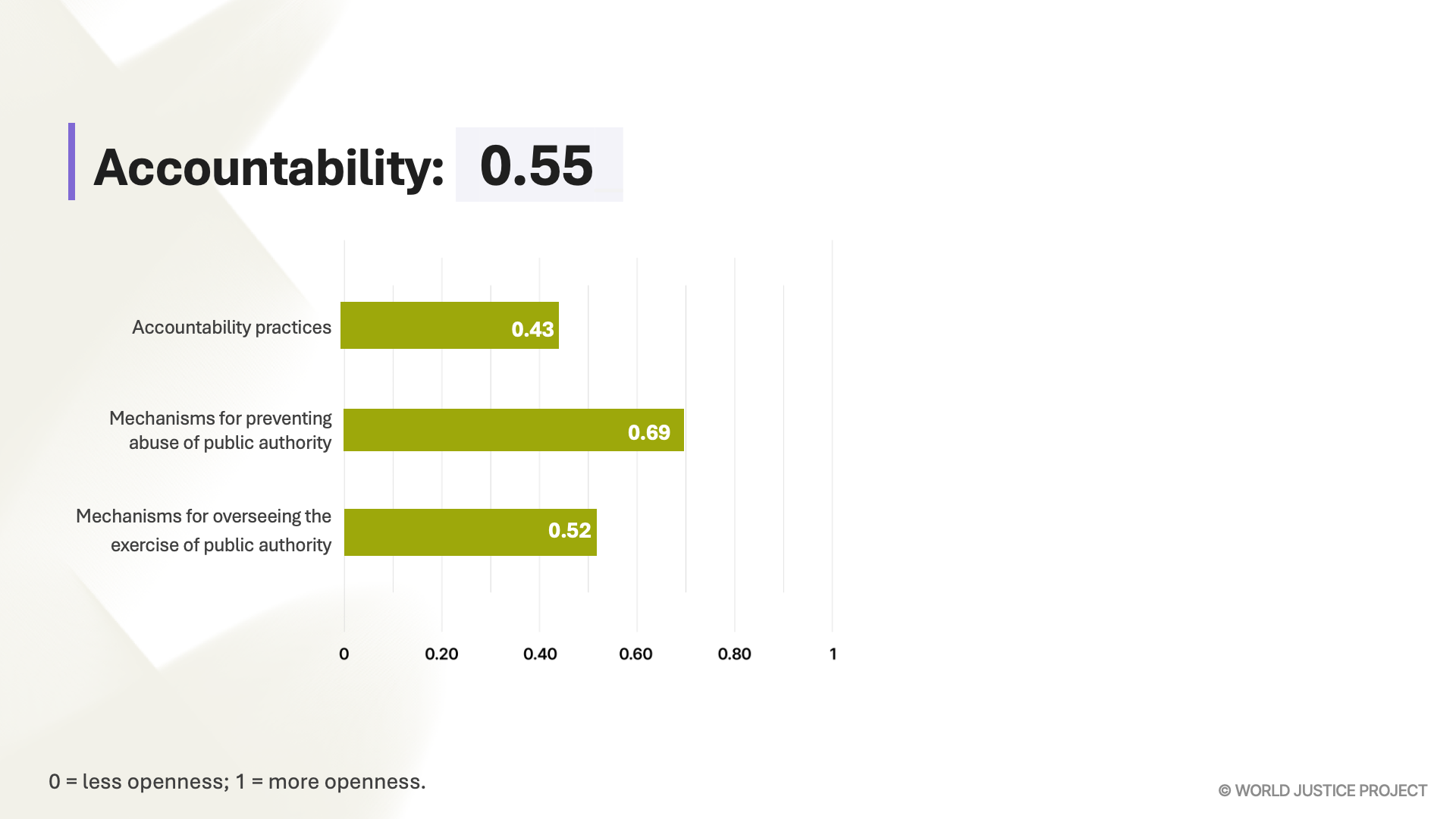
- Dominican institutions showed strong practices that contribute to closing the space for corruption. Examples of these are the existence of Ethics Codes, and the efforts to communicate accountability responsibilities to the staff.
- Nonetheless, the disciplinary proceedings' consequences were not accessible across the ecosystem.
- However, the data also showed that public justifications for governance decisions—such as the appointment of institutional heads—are not always accessible. Making these decisions more transparent would strengthen open justice and help build greater trust in institutions.
Groundbreaking participatory practices serve as blueprints for other institutions, advancing a more open justice system as a whole
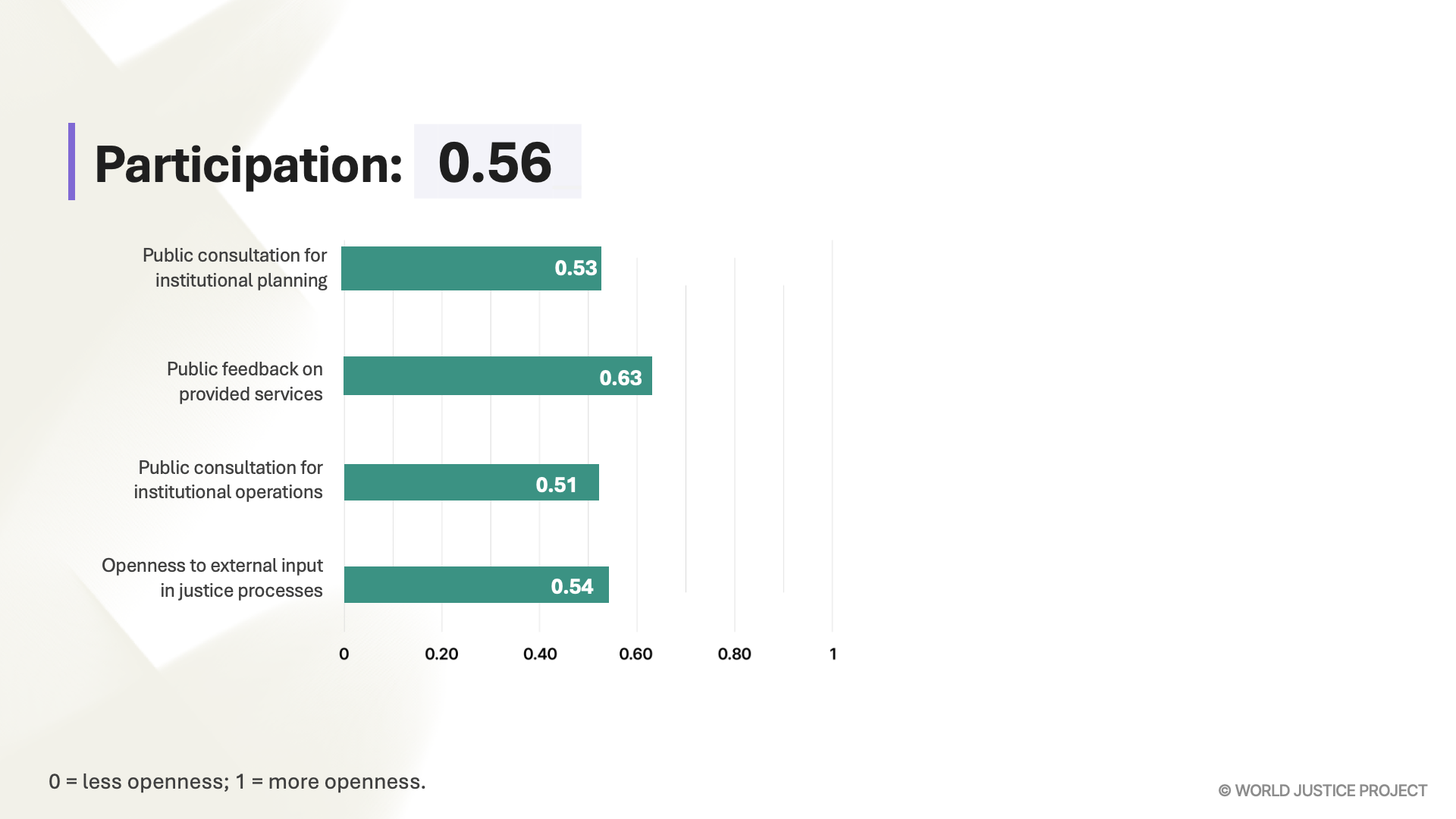
- Although general consultation spaces are in place, institutions still need to integrate users’ perspectives into their planning tools to ensure they respond to the needs of the populations they serve.
- Further, special attention should be paid to closing inequality gaps by creating participatory spaces for groups living in vulnerable conditions.
- Expanding deliberative participation in decision-making, including through mechanisms such as amicus curiae, remains a pending task. However, some exceptional practices have integrated civic insights into high-profile corruption cases, strengthening criminal investigations.
- Internal governance is one area where civic participation remains limited. Currently, only three institutions3 allow civil society actors to propose candidates for, and oversee, the appointment of institutional heads, setting an important precedent for high-level participatory processes.
- The DR-OJM is a study conducted by WJP that analyzed 21 institutions that participate in justice processes. It is an initiative of the Judiciary Power of the Dominican Republic, as part of its efforts to promote an agile, transparent and accessible justice. The project was also accompanied by the United Nations Development Program in the Dominican Republic. ↩
- The OJM also included a module to deepen the analysis of four institutions: Judiciary, Attorney General, Public Defense, and Human Rights Commission, through the assessment of 23 local / specific offices (ex. Appeals Courts, Specialized Prosecutions; Regional Public Defense Offices). The methodology was essentially the same, although it used 23 indicators (out of 73), reflecting their administrative responsibilities. ↩
- These institutions are the Judiciary Power, The Constitutional Court, and the Superior Electoral Court. The evidence of these practices, as well as the documental support that was collected for the whole study, are publicly available as part of the DR-OJM. ↩