
About Us

The WJP is an independent, multidisciplinary organization working to advance the rule of law worldwide.
Our Work

We engage advocates from across the globe and from multiple work disciplines to advance the rule of law.
What two decades of survey evidence from England and Wales reveal about the justice needs, inequality, and the effect of digitalization, in the context of reforms.
Over the past two decades, civil procedure, legal aid, court administration, and digital justice services in England and Wales have undergone sweeping transformations. Yet, institutional metrics such as court speed, case volume, and process efficiency offer only a partial view of whether these reforms serve the public. Assessing whether people obtain the assistance they need, resolve their everyday legal disputes, and experience fair treatment requires looking beyond court administration to the experiences of individuals navigating the system.
World Justice Project’s (WJP) Understanding the justice needs gap in England and Wales, written in collaboration with the Nuffield Foundation, synthesizes data from three national surveys (2004, 2014–15, and 2023) alongside 20+ years of reform evidence to evaluate how these major policy shifts have shaped everyday access to justice.
The Justice Gap: High Need, Persistent Access Barriers, Low Trust
Experiencing a civil or administrative justice problem is common, but accessing effective help remains out of reach for millions. Data from 2023 shows that over one in three adults in England and Wales experienced a non-trivial justice problem —involving a disagreement that they considered at least moderately serious—in the preceding four years[1]. Housing, family, and accident and health-related justice problems were most common.
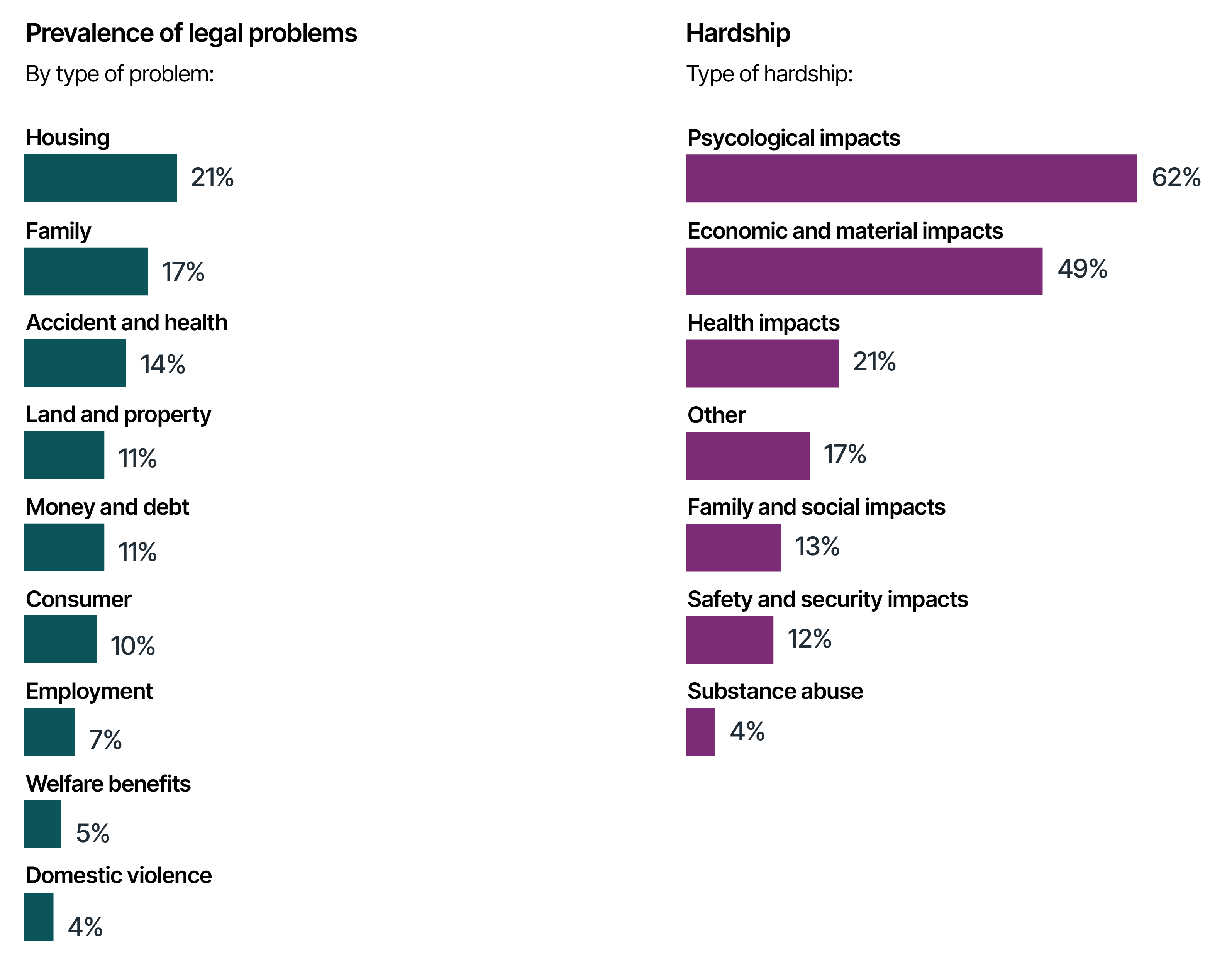
Nearly one-third of people with non-trivial problems experienced hardships in two or more areas of their lives, including finances, health, relationships, and personal safety. Around three in five people with justice problems also experienced psychological impacts. Almost half experienced financial distress.
Among people who needed help, 38% did not obtain it; 30% of those who needed a process or service to resolve a dispute could not access one.
Even after process conclusion, only 72% reported fully resolving their justice problem, and 55% considered the process fair. Crucially, problem resolution was lowest among those who accessed a formal dispute mechanism without receiving initial advice or representation: different forms of support need to work together.
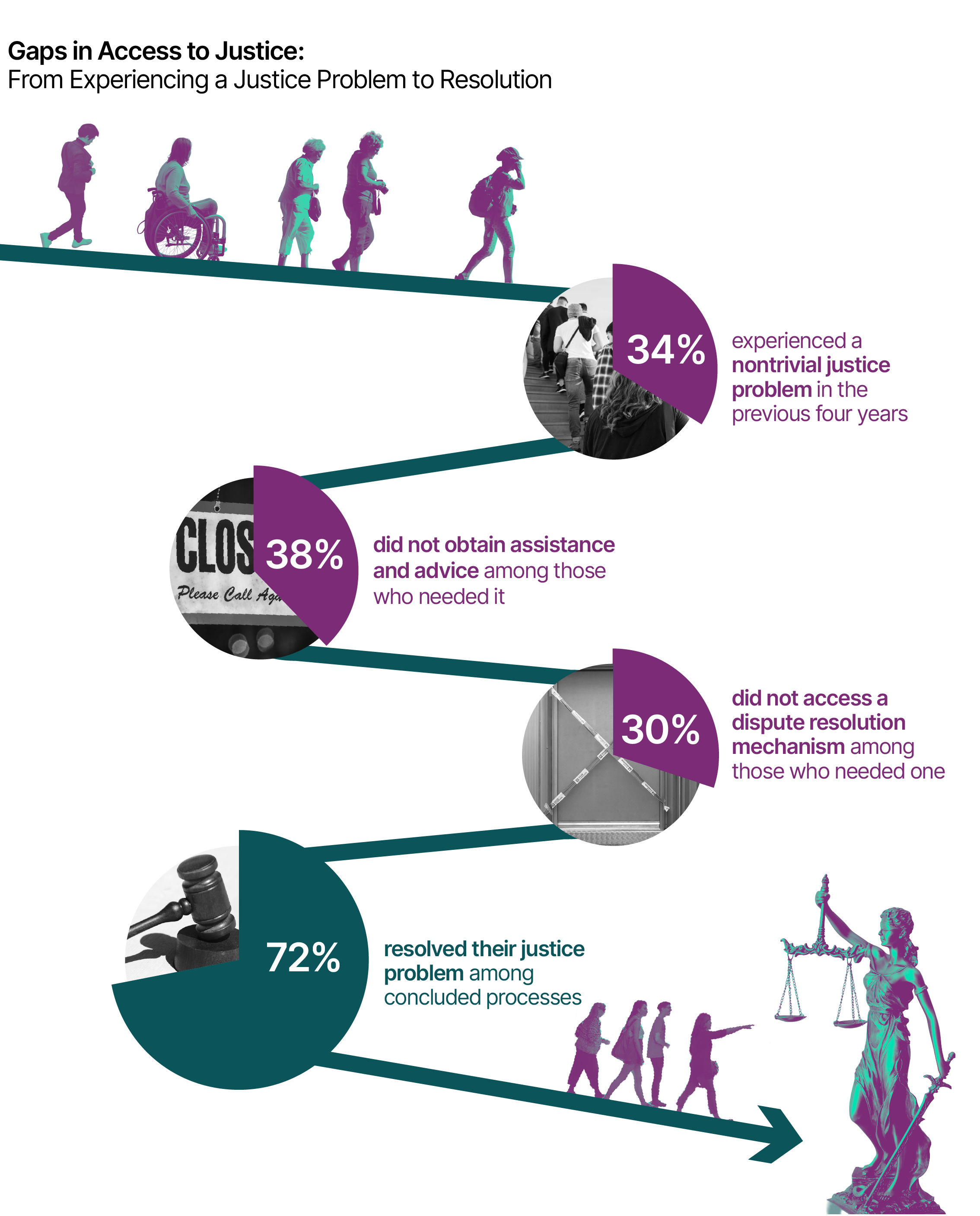
Public confidence in justice actors appeared critically low. Trust metrics reveal a systemic disconnect between the public and justice institutions:
- Low trust in competence: Only 29% of individuals experiencing a justice issue trusted the competence and accessibility of civil justice actors and legal practitioners.[2]
- Deficit in perceived fairness: A mere 10% trusted that justice actors operate fairly across different socioeconomic backgrounds, reflecting a widespread belief that financial resources dictate legal outcomes.[3]
Who Struggles Most?
Disadvantage across the justice journey does not follow a single pattern, but legal capability—the combination of knowledge, confidence, and skills required to recognize and address justice problems—serves as the primary dividing line.
- The Capability Divide: Among concluded processes, individuals with lower legal capability were 10 percentage points less likely to resolve their problems (66%) compared to those with higher capability (76%). They also reported lower trust, longer delays, and lower satisfaction.
- Disability and Hardship: Individuals with disabilities were 1.7 times more likely to experience multiple life hardships alongside their legal problems and faced lower resolution rates.
- Nature of Problems by Income: While overall problem frequency was similar across income brackets, low-income households were disproportionately exposed to high-stakes survival issues such as welfare benefits, debt, homelessness, and eviction.
Most Reforms do not Appear to Improve Problem Resolution Rates
Examining justice outcomes across distinct eras of justice reform suggests no consistent improvements in problem resolution for vulnerable populations:[4]
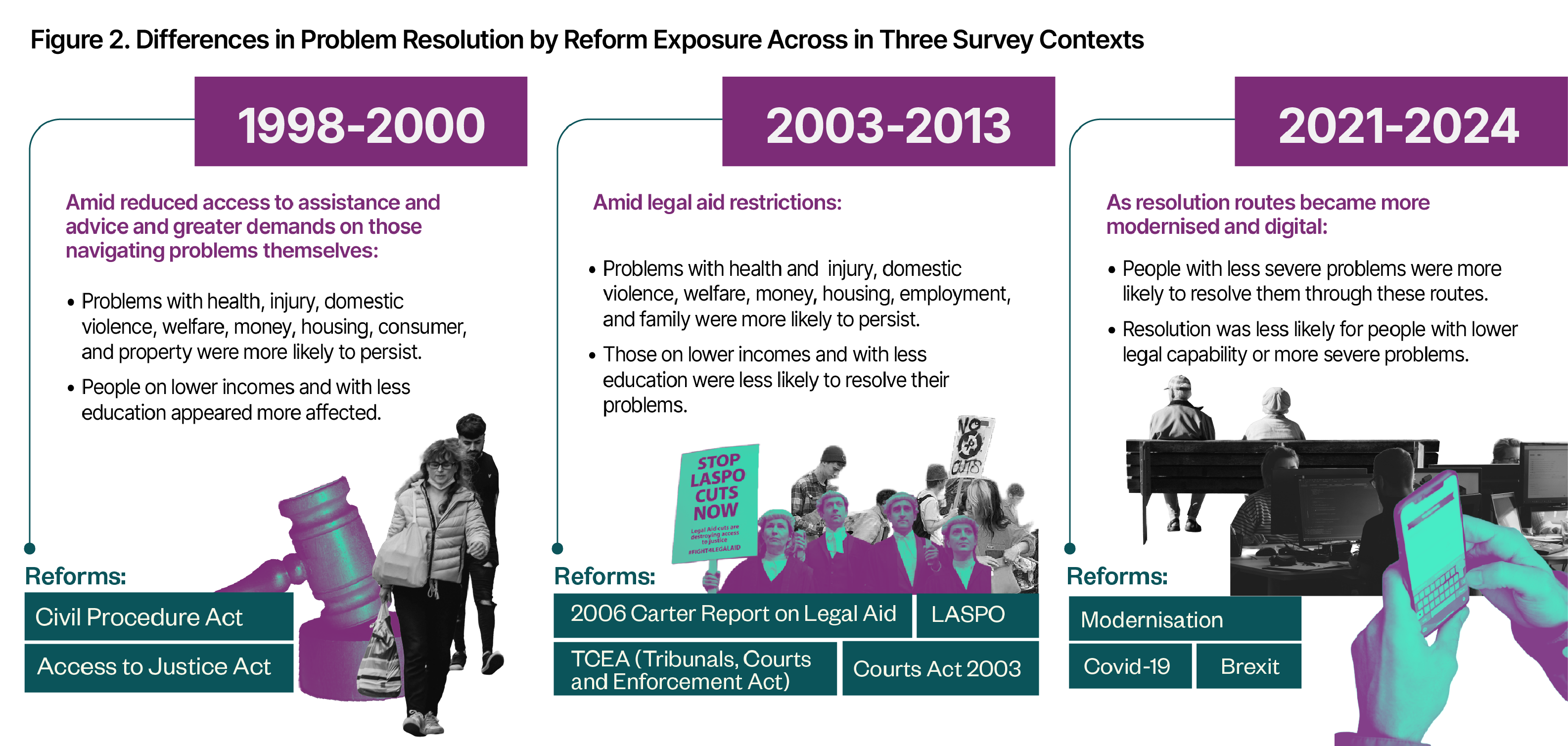
Note: Each panel shows a separate survey snapshot, not changes over time. Evidence of lower problem resolution was strongest in 2014–15, while findings for 2004 and 2023 were less certain. The findings do not establish that reforms caused these differences.
Early Procedural Reforms (1998 - 2000): The late-1990s changes encouraged earlier settlement and demanded more case preparation, while publicly funded legal aid was reorganized.. People who experienced problem areas that were more directly affected by these reforms appeared less likely to resolve them, with larger estimated shortfalls among people on lower incomes and with less education.[5]
Court and Tribunal Reforms and Legal Aid Restrictions: Against a backdrop of major court reorganization and fiscal restraint, the data suggest the sharpest resolution shortfalls. Changes to legal aid also increased pressure on providers and restricted publicly funded assistance. For people on lower-incomes, the likelihood of resolution was 21 percentage points lower if they experienced problems such as family, welfare, or housing, which were more directly affected by reforms, than if they experienced other types of problems.
Digital Modernisation: COVID-19 accelerated court digitization and remote hearings aimed to make the court and tribunal processes more efficient and accessible. However, WJP found little overall difference when comparing the resolution rates for people who used dispute resolution routes more directly affected by Modernisation and those who used less affected routes. Instead, estimates suggest lower resolution among people with lower legal capability or more severe problems who used relatively more modernized resolution routes.[7]
How can existing evidence help shape better justice reforms?
Financial constraints force difficult choices. Reform should be judged not only by costs, speed or cases closed, but also by whether different groups obtain needed support and resolve justice problems fairly.
To build a genuinely people-centered justice system, future policy should focus on five core priorities:
- Design for Disadvantages: Justice processes should account for how different disadvantages reinforce one another, including how people on lower incomes are more exposed to issues like welfare, housing, and debt while also having fewer resources to replace unavailable support.
- Treat Support and Resolution as Complementary: Digital portals and formal courts may fall short if people cannot navigate them effectively. Prioritize early advice, clear entry points, and sustained human assistance alongside formal routes.
- Explicitly Address Reform Trade-Offs: Recognize that streamlining institutional processes can shift administrative and preparation burdens onto individuals.
- Measure People-Centered Outcomes: Track problem resolution, process fairness, and hardship arising from justice problems, including for groups in vulnerability, rather than relying solely on court statistics on costs, speed, and cases closed.
- Build Better Evidence for Future Reform: Use comparable questions and measures across surveys and combine findings with records from courts and legal assistance providers to better understand people's justice experiences.
Methodological Innovation & Strategic Applications
Assessing justice outcomes using surveys spanning 20+ years presents significant technical challenges. The analytical framework applied here offers a structured approach to drawing comparable evidence from three surveys with different designs to map population-level gaps in justice outcomes and inequalities.
Legal needs surveys are essential because they capture justice problems that never reach formal institutions. To make better use of this evidence, the research adapts standardized people-centered justice outcome indicators co-developed by WJP.[6] These indicators are then combined with evidence on reform design and implementation to examine how justice services may relate to people's outcomes, highlighting patterns that can help inform future reform. Legal needs surveys are essential because they capture justice problems that never reach formal institutions.
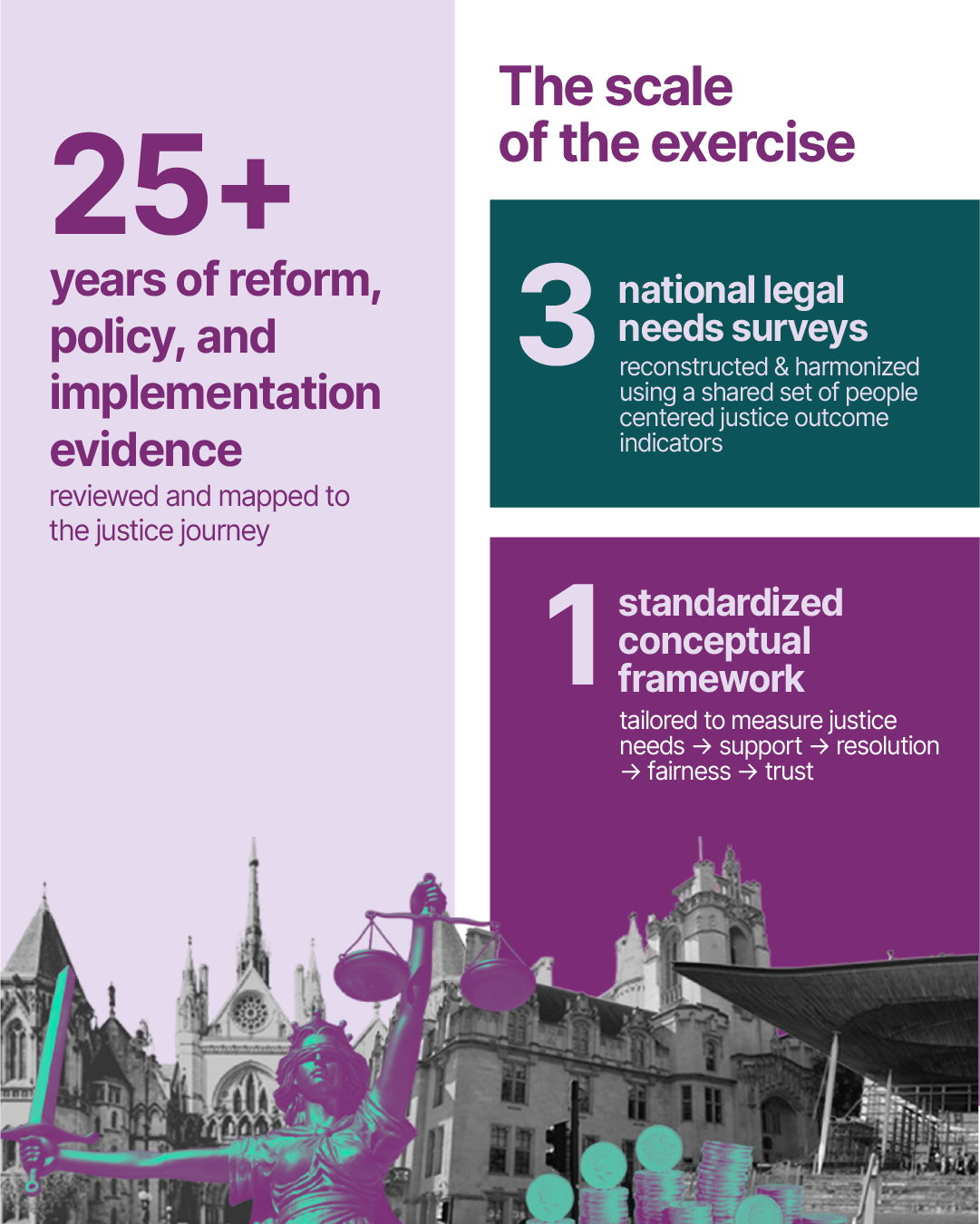
Figure 3. Scope of the Review: Three National Surveys and More Than Two Decades of Justice Reform
By harmonizing comparable measures for three distinct national surveys within a standardized indicator framework, this approach reveals how justice gaps manifest across different reform contexts. While the findings show associations rather than direct causation, they demonstrate how existing legal needs data—which captures disputes that never reach formal courts—can guide future policy design.
Footnotes
- Data analysis from the 2023 Individual Legal Needs Survey (ILNS) commissioned by the Legal Services Board and The Law Society. ↩
- Trust is measured through a composite indicator capturing perceptions of the civil justice system’s efficiency, accessibility, and value, alongside lawyers’ responsiveness and suitability as sources of help. ↩
- Trust in fairness is measured through a composite indicator capturing perceptions of whether financial resources affect legal outcomes, the affordability of legal help, and the quality of representation available to people with more and less financial resources. ↩
- Understanding the justice needs gap in England and Wales examines three surveys: the Legal Service Commision’s 2004 English and Welsh Civil and Social Justice Survey, the 2014–15 Legal Problem Resolution Survey (LPRS) commissioned by the UK Ministry of Justice's, and the 2023 ILNS. Each is interpreted alongside a structured review of justice reforms, policy documents, evaluations, and broader access-to-justice research. ↩
- Although the estimates were uncertain, this pattern is consistent with wider research raising concerns about asking people to do more without adequate support. ↩
- Results based on the 2014-15 LPRS. ↩
- Although statistically uncertain, these findings echo wider evidence showing how digital services can simplify some processes while leaving others needing more tailored support. ↩
- HiiL, Pathfinders for Peaceful, Just, and Inclusive Societies, OECD, and WJP. (forthcoming). Measuring the Outcomes of People-Centered Justice: A Set of Internationally Comparable Outcome Indicators.