

About Us

The WJP is an independent, multidisciplinary organization working to advance the rule of law worldwide.
Our Work

We engage advocates from across the globe and from multiple work disciplines to advance the rule of law.

The rule of law is a vital economic asset for the private sector. Learn how predictable legal systems drive investment, mitigate risk, and why businesses must advocate for judicial independence in an era of global backsliding.
This article is based on Alejandro Ponce’s opening remarks for the World Justice Project’s first Business Forum on the Rule of Law, held in Tokyo in January 2026.
For a construction company in Mexico, the rule of law is not a legal abstraction—it is the difference between growth and survival. After a series of projects were completed for a government client, payments stopped. Under a previous system, the company would have sought a remedy in court. However, following recent judicial reforms that have led to a slower, more politicized justice system, that path is now fraught with uncertainty. Instead of expanding, the firm is now freezing investments and cutting costs.
This scenario illustrates a critical reality: a weak rule of law is a direct business problem. When everyone—including government—is not held accountable to clear, equally applied rules, the private sector loses the confidence required for long-term planning.
The Economic Impact of Legal Certainty
Data from the World Justice Project (WJP) Rule of Law Index consistently shows that countries with a stronger rule of law attract more investment and achieve higher income levels . This relationship holds true even within relatively stable regions like the European Union; areas with more robust legal frameworks perform better economically.
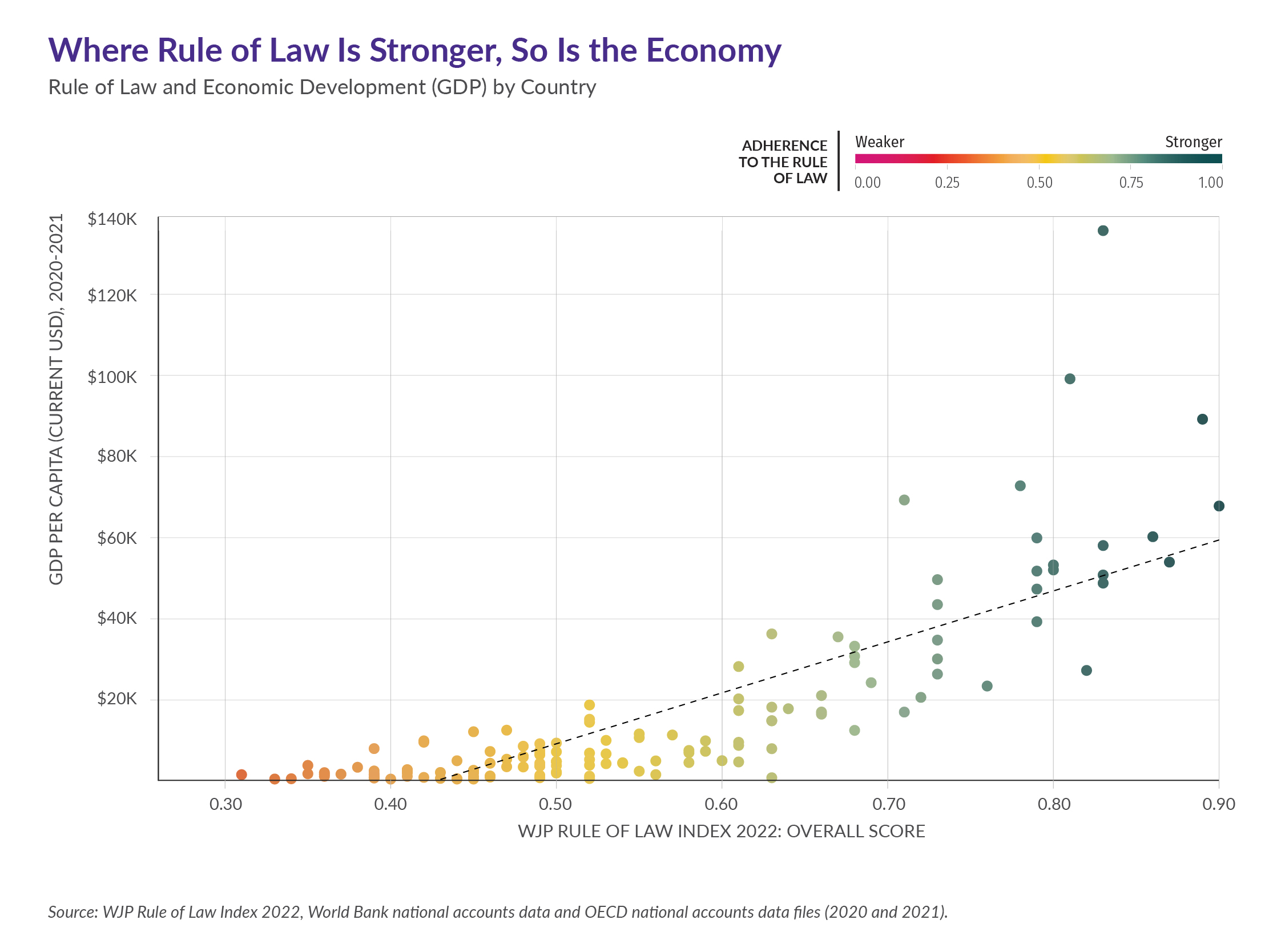
For multinational companies and credit rating agencies, these metrics provide a lens into political risk and legal certainty. The rule of law functions as a core economic asset through five primary mechanisms:
- Predictability: Businesses must know that rules will not change overnight. Stability lowers the cost of capital and protects against political interference.
- Credible Contracts: Efficient courts allow deals to move faster and supply chains to grow. When trust in the court system disappears, business becomes personal and risky.
- Arbitrariness Protection: Strong legal systems limit state power, protecting companies from sudden expropriation or unfair treatment.
- Fair Competition: When laws are applied equally, innovation drives productivity rather than corruption or favoritism.
- Innovation: The assurance that technology and data will be protected encourages long-term investments in the future.
The Global Trend of Rule of Law Backsliding
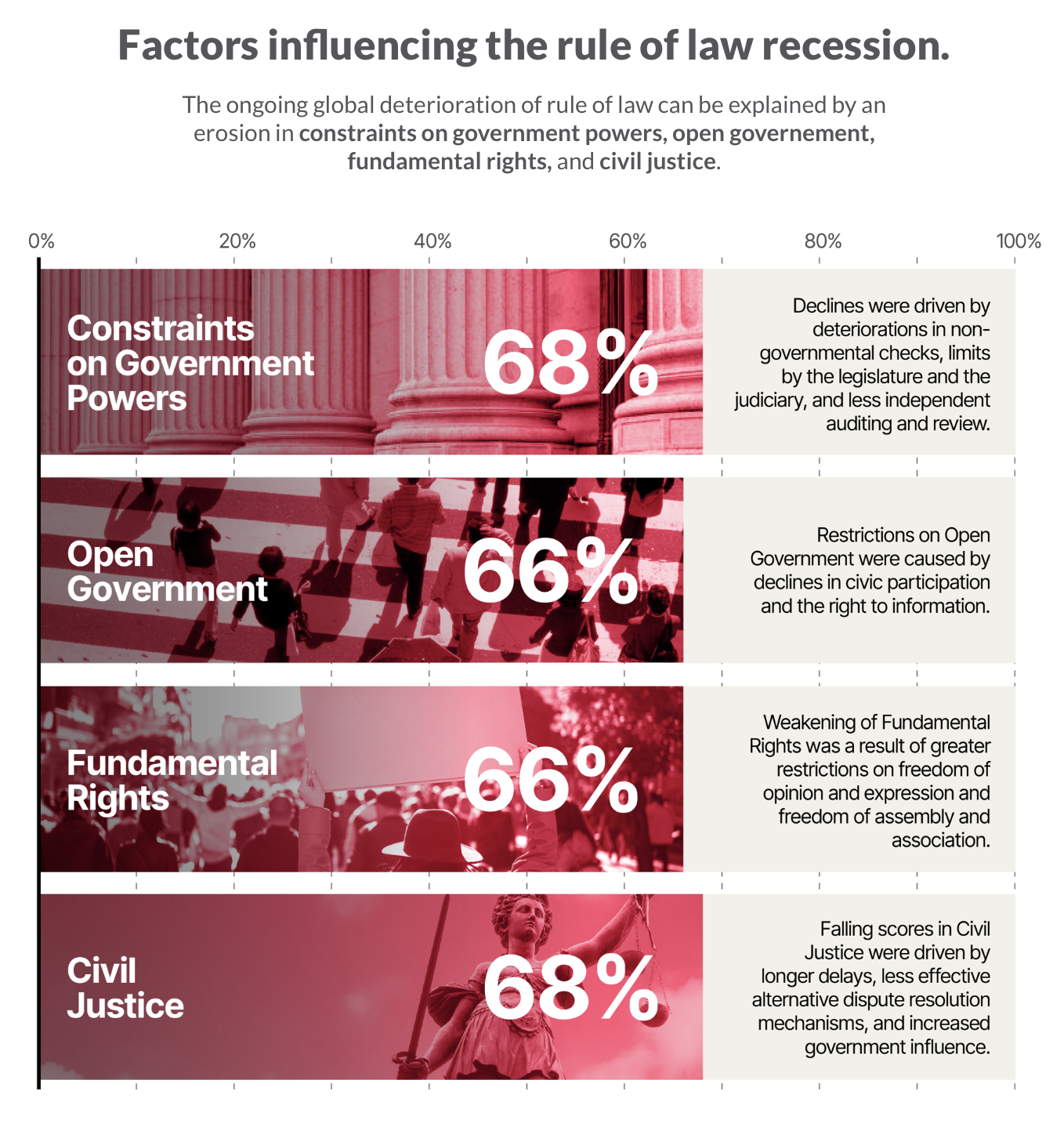
As the world navigates increasing economic fragmentation and heightened geopolitical tension, more countries are currently weakening their legal institutions than strengthening them. Between 2024 and 2025 alone, 68% of countries worldwide experienced a decline in their rule of law scores .
This erosion typically manifests through increased political pressure on the judiciary, a steady decline in transparency and open government, and the systematic removal of institutional checks and balances. For businesses, this democratic backsliding is more than a political concern; it translates directly into higher operational costs and a significant loss of market confidence.
How Companies Can Mitigate Risk and Strengthen the System
Businesses need not be victims of a weakening legal environment; they can be active participants in its recovery.
Assessing and Managing Risk
To effectively manage these challenges, companies must elevate the rule of law to a core business risk, integrating it into their broader strategic framework. This begins with deep analysis, where firms rigorously evaluate judicial independence and contract enforcement in every market where they operate.
Strategic integration is essential; institutional risk should be a primary factor in pricing models, supply chain management, and market entry decisions. Finally, building internal resilience through robust governance and compliance systems ensures that a business can remain agile and protected even within increasingly volatile environments.
Advocacy and Collaboration
The private sector is uniquely positioned to push back against the erosion of legal standards by leveraging its collective voice to advocate for judicial independence and greater transparency. By working through business associations and chambers of commerce, companies can help shape more predictable policies that stabilize the market.
Furthermore, engaging with organizations like the World Justice Project allows leaders to move away from intuition-based decisions in favour of rigorous, evidence-based risk management.
The rule of law is the bedrock of private sector growth, and its strength is a shared responsibility. As shifting legal landscapes demonstrate, institutional erosion creates immediate, tangible business costs. By utilizing evidence-based tools and engaging in collective advocacy, companies can move from being victims of uncertainty to becoming active architects of a stable, predictable economic future.